
8 min read · Last updated November 19, 2026
- The 2026 High Deductible Plan G deductible is $2,950, up from $2,870 in 2025, per the Centers for Medicare & Medicaid Services (CMS).
- Real 2026 Washington state rates show standard Plan G at $291 a month versus $76 for High Deductible Plan G, a $2,580 annual premium gap.
- The actual breakeven point is about $2,863 in a single year’s Medicare Part A and Part B costs, not a fixed number of years.
- Even in a year the full $2,950 deductible gets used up, High Deductible Plan G costs only about $87 more than standard Plan G, using these filed rates.
In 2026 the High Deductible Plan G deductible is $2,950. A beneficiary paying real Washington state 2026 rates breaks even against standard Plan G at roughly $2,863 in a year’s Medicare Part A and Part B costs.
In this article
- What the High Deductible Plan G deductible actually requires
- The real 2026 premium gap
- The breakeven line: $2,863 a year
- A good year and a bad year, side by side
- Frequently asked questions
Say a Medicare beneficiary, Bettina Voss, got two real quotes this fall, inside the Annual Enrollment Period (AEP), the October 15 to December 7 window when beneficiaries can switch Medigap or Medicare Advantage coverage.
One quote is for standard Plan G. The other is for High Deductible Plan G, the same coverage with a much lower premium and a $2,950 catch. Below roughly $2,863 in yearly Medicare costs, that catch works in her favor; above it, standard Plan G usually wins, though not by much.
What the High Deductible Plan G deductible actually requires
High Deductible Plan G works exactly like standard Plan G after one condition is met. Bettina has to personally pay $2,950 in Medicare Part A and Part B deductibles, coinsurance, and copayments before the plan pays a cent. The Centers for Medicare & Medicaid Services (CMS) sets this figure every year under Section 1882(p)(11) of the Social Security Act, adjusting it by the prior year’s Consumer Price Index for Urban Consumers (CPI-U) and rounding to the nearest $10.
The 2026 amount, $2,950, is 2.79% higher than 2025’s $2,870.
The 2026 Medicare Part B deductible, $283, counts toward that $2,950. Standard Plan G already requires Bettina to pay that same $283 herself, since Plan G hasn’t covered the Part B deductible for anyone since its 2020 redesign.
So the first $283 of exposure is identical under both plans: everything above that is where they actually diverge. Once Bettina’s out-of-pocket Medicare costs reach $2,950 in a calendar year, High Deductible Plan G pays exactly what standard Plan G would have paid all along. That means 100% of her remaining Medicare-approved Part A and Part B costs for the rest of that year.
Don’t confuse this with High Deductible Plan F, a separate, closed product. CMS restricts High Deductible Plan F to beneficiaries who were already eligible for Medicare before January 1, 2020. High Deductible Plan G carries no such restriction, which makes it the only high-deductible Medigap option open to someone newly eligible for Medicare today.
The two plans have historically shared the same dollar deductible figure, but they are not interchangeable products. Choosing between any Medigap plan and Medicare Advantage is a separate decision that comes before this one.
The real 2026 premium gap
National premium ranges for Medigap plans get quoted everywhere, and few of them point to one actual filed rate. Washington state’s 2026 Medicare Supplement filings give a real, named comparison instead.
Premera Blue Cross’s own 2026 rate filing, approved by the Washington state Office of the Insurance Commissioner (OIC) and effective April 1, 2026, prices standard Plan G at $291 a month for a non-spousal policyholder. Its High Deductible Plan G runs $76 a month under the same filing. That is a $215 monthly gap, or $2,580 a year, in premium alone.
A beneficiary’s own age moves standard Plan G’s premium just as much as the plan choice does, before the high-deductible question even comes up. High Deductible Plan G follows the same age-rated pattern, starting from a much lower base.
| What you pay | Standard Plan G | High Deductible Plan G |
|---|---|---|
| Washington, 2026 (Premera, non-spousal) | $291/month | $76/month |
| Annual premium | $3,492 | $912 |
| What you self-pay before the plan pays anything | Only the $283 Part B deductible | Up to $2,950 in Medicare Part A and B costs |
| Total annual cost in a low-cost year ($623 in Medicare costs) | $3,775 | $1,535 |
| Total annual cost in a year the deductible is fully used | $3,775 | $3,862 |
| Best for | Anyone who expects frequent care or wants one flat, predictable bill | Anyone whose yearly Medicare costs usually stay under about $2,863 |
Line Premera’s actual numbers up against CMS’s $2,950 deductible, and the usual pitch starts to wobble. A $2,580 annual premium gap sounds like it should comfortably outrun a $2,950 deductible. It doesn’t, not quite, once the shared $283 Part B deductible is pulled out of the comparison.
The breakeven line: $2,863 a year
Standard Plan G’s total annual cost is fixed. It’s the $3,492 premium plus the $283 Part B deductible, for a flat $3,775, no matter how much care Bettina uses that year.
High Deductible Plan G’s total cost moves with her actual spending. Her premium is $912, plus whatever she pays out of pocket toward the $2,950 deductible. Call that out-of-pocket amount X: her total cost for the year is $912 plus X, as long as X stays at or under $2,950.
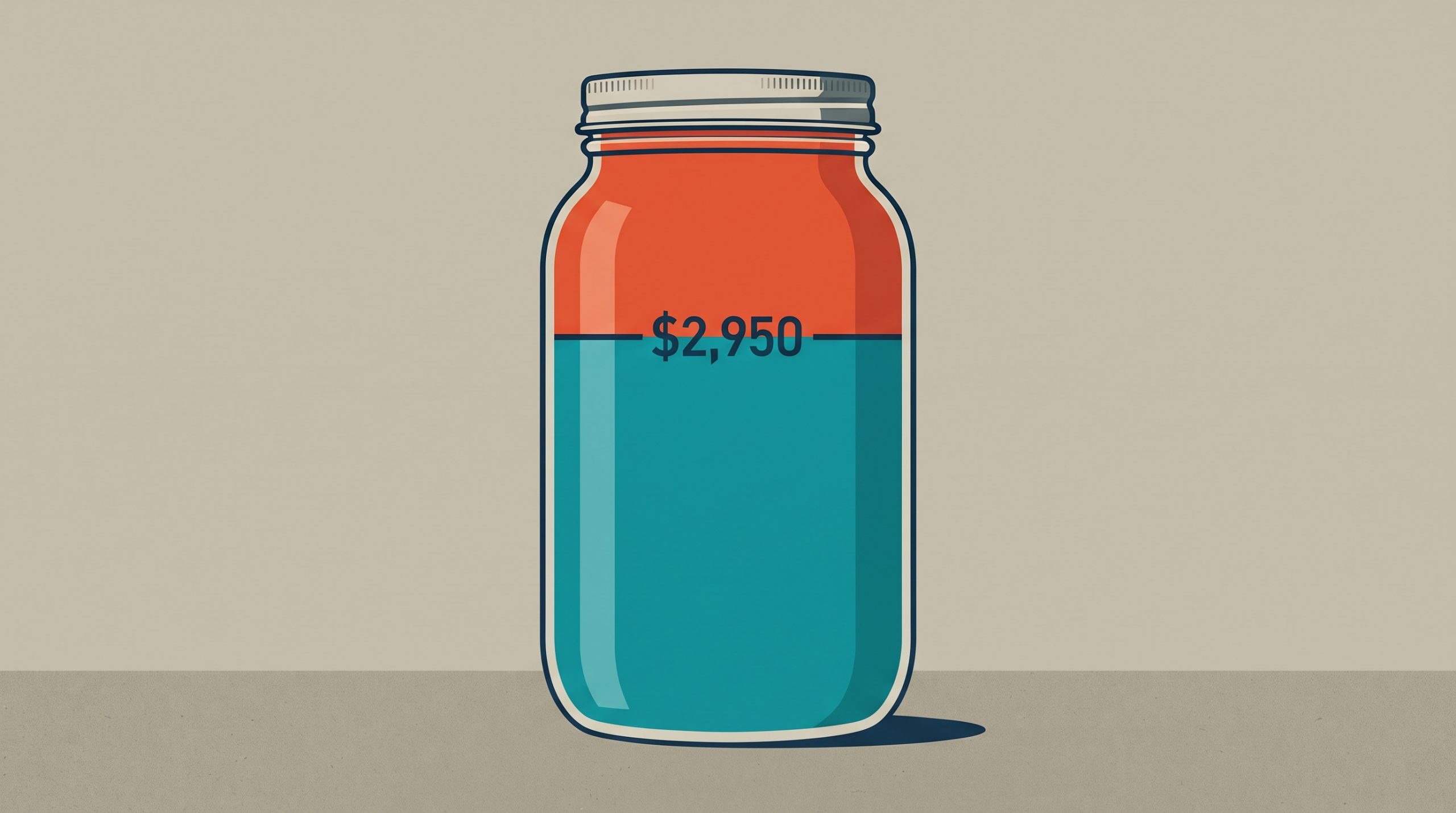
Set the two totals equal to find the breakeven point: $912 + X = $3,775, so X = $2,863. Below $2,863 in yearly Medicare Part A and Part B costs, High Deductible Plan G is the cheaper plan that year. Above $2,863, standard Plan G would have cost her less, and the gap widens until the deductible is fully used up.
A good year and a bad year, side by side
In a typical year, Bettina pays her $283 Part B deductible plus about $340 in coinsurance on a couple of specialist visits: $623 total. Under High Deductible Plan G, that year costs her $912 in premium plus $623 out of pocket, $1,535 total.
Under standard Plan G, that same year costs a flat $3,775. High Deductible Plan G saves her $2,240 that year.
Now suppose one year she has a hospital stay and uses the full $2,950 deductible.
That year costs her $912 plus $2,950, or $3,862, under High Deductible Plan G.
Standard Plan G still costs $3,775 that year. High Deductible Plan G costs her $87 more, using Premera’s actual 2026 rates.
Run both plans over five years: four typical years like the one above, plus one maxed-out year. Bettina pays $10,002 total choosing High Deductible Plan G and $18,875 choosing standard Plan G, an $8,873 net savings even with the bad year folded in.
The premium gap does nearly all the work. The deductible only claws back a small amount, and only in the specific year she actually spends that much.
Frequently asked questions
What is the 2026 deductible for High Deductible Plan G? The High Deductible Plan G deductible is $2,950 for 2026, set by the Centers for Medicare & Medicaid Services (CMS) under the Social Security Act’s annual inflation adjustment. It rose from $2,870 in 2025. A beneficiary must pay this amount out of pocket toward Medicare Part A and Part B costs before High Deductible Plan G pays anything.
Is High Deductible Plan G worth it? It depends on your actual yearly Medicare costs, not a general rule. Using real 2026 Washington state rates, High Deductible Plan G is the cheaper choice in any year your Part A and Part B costs stay under about $2,863. Above that line, standard Plan G usually wins, though only by a modest margin.
Does the Part B deductible count toward the High Deductible Plan G deductible? Yes. The 2026 Part B deductible, $283, is the first piece of the $2,950 High Deductible Plan G deductible. Standard Plan G already requires you to pay that same $283 yourself, so it isn’t an extra cost unique to the high-deductible version.
What’s the difference between High Deductible Plan F and High Deductible Plan G? High Deductible Plan F is closed to anyone who became eligible for Medicare on or after January 1, 2020. High Deductible Plan G has no such restriction and is the only high-deductible Medigap option open to someone newly eligible for Medicare today, even though both plans have historically carried the same dollar deductible.
How much can High Deductible Plan G actually save compared to standard Plan G? Using Premera’s real 2026 Washington state rates, standard Plan G runs $291 a month versus $76 for High Deductible Plan G, a $2,580 annual premium gap. In a low-cost year that can mean savings over $2,000. In a year you fully use the $2,950 deductible, most of that savings disappears, but it rarely turns into a real loss.
Compare Medigap Plan G rates in your state