8 min read · Last updated September 19, 2026
- The Agreed Value option on a commercial property policy suspends the coinsurance penalty, but only until a fixed expiration date, typically 12 months out, printed on the declarations page.
- The option is conditioned on a signed Statement of Values (SOV). If it isn’t refiled at renewal, coinsurance comes back into force automatically, with no notice.
- A shortfall between your filed value and your property’s real value at the time of loss can cost tens of thousands of dollars on an otherwise fully covered claim.
- Commercial property renewal rates were running +6.16% as of July 2026 (Ivans Index), still rising year over year even as the pace eases from +6.40% in Q2 — which means the value on file from even two years ago is very likely stale today.
In this article
- What the agreed value option actually does
- Why does agreed value coverage have an expiration date?
- The renewal step that quietly undoes it
- Run the math before your next renewal
- Frequently asked questions
Hector Delacroix built his custom cabinetry shop over eleven years, and the fire that tore through his finishing room in March didn’t destroy the business. His insurer’s math did most of that on its own.
The building and its contents were worth $2,000,000 the day the fire started. Hector’s policy carried a $1,500,000 limit, the same limit an agent had set three years earlier when Hector added Agreed Value coverage to stop the insurer from second-guessing his numbers after a claim. The loss came to $700,000. Hector expected a check for roughly that amount, minus his $2,500 deductible.
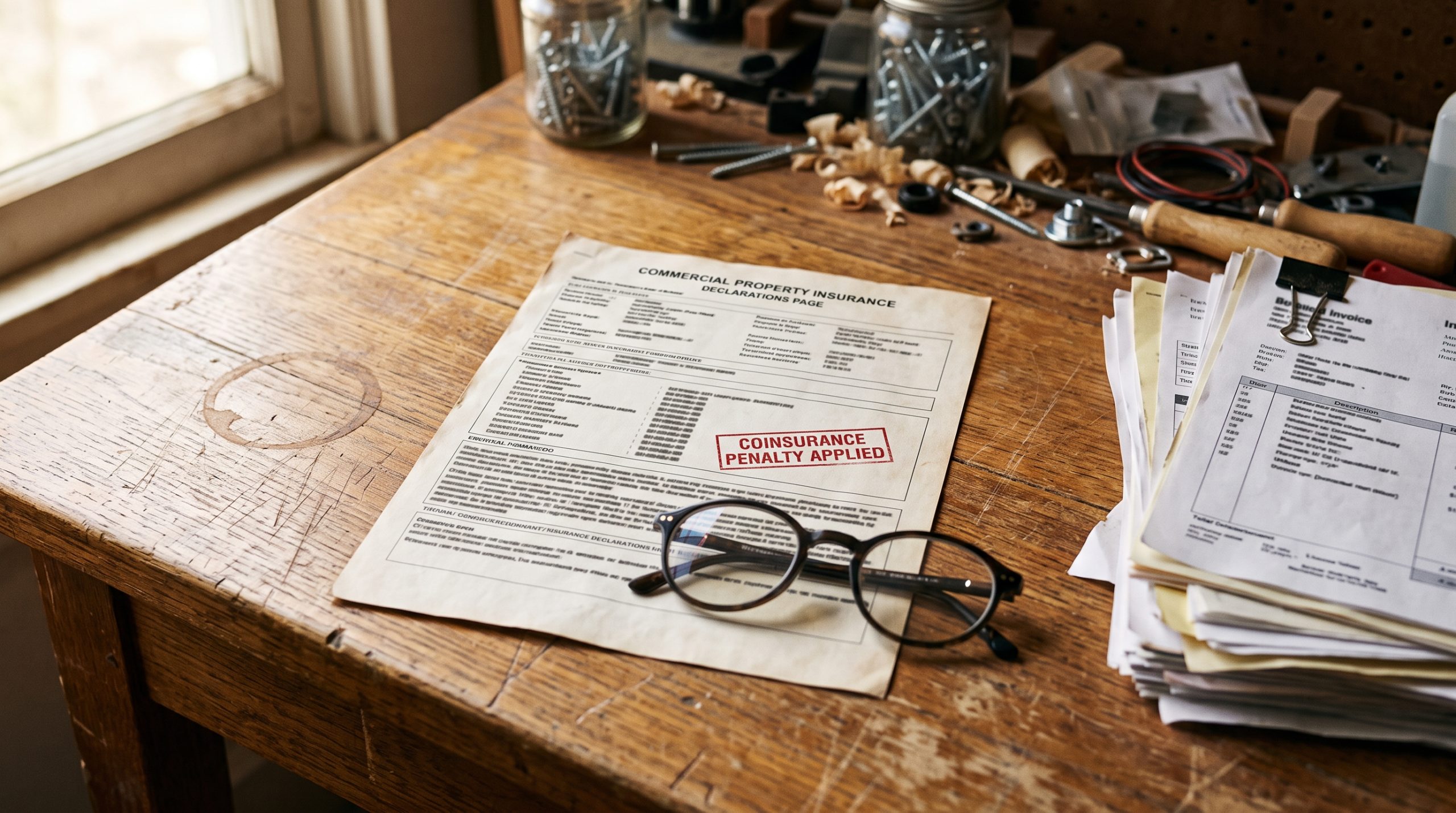
He got $653,750. Nobody denied a dollar of the claim. His policy simply wasn’t running on Agreed Value anymore, and he had no idea it had stopped.
What the agreed value option actually does
Every standard commercial property policy carries a coinsurance condition. If the value of your building and contents at the time of a loss, multiplied by your coinsurance percentage on the declarations, works out to more than your policy limit, the insurer only pays that same shortfall percentage of any claim. Most business owners never test this math until a loss forces them to.
Agreed Value is an optional coverage that turns that test off. The Insurance Services Office (ISO), the organization that writes the standard policy language most commercial property insurers use, publishes an analysis describing it as Optional Coverage G.1 inside the standard Building and Personal Property Coverage Form: while it’s active, “the coinsurance condition does not apply.” Instead, the insurer pays based on the proportion your limit bears to the agreed value on file, up to that limit.
The word “agreed” is doing real work in that name. The International Risk Management Institute (IRMI), a widely used reference for commercial insurance terms, defines it plainly: insurers require “a statement of property values signed by the insured as a condition of activating or including an agreed value provision.” The insurer isn’t taking your word for the number. You submit a signed Statement of Values, the underwriter reviews it, and the two of you agree that number is close enough to reality that the coinsurance test can be waived for a while.
That last phrase, for a while, is the part almost every policyholder skips past.
Why does agreed value coverage have an expiration date?
An agreed value determination is only as good as the number behind it, and property values don’t hold still. A three-year-old Statement of Values on a growing cabinetry shop, or a retailer’s holiday inventory, or a restaurant that just finished a buildout, stops describing reality fast. So the option itself expires on a fixed date printed on your declarations page, typically 12 months out from the date it was added or last renewed.
That expiration date is the whole mechanism. If a loss happens before it, coinsurance stays off. If a loss happens after it, per the same ISO analysis, “the coinsurance condition is reinstated, and the option no longer applies.” Nothing about your policy number changes. Nothing shows up as a lapse on any notice you’d think to look for. The building is insured the whole time. The one thing that quietly turns off is the waiver that was protecting you from your own out-of-date numbers.
The renewal step that quietly undoes it
Extending Agreed Value coverage isn’t automatic, and it isn’t free. It requires submitting an updated, signed Statement of Values before the expiration date, so the insurer can agree to a new number for the new term. Skip that step, whether because the renewal came up while you were dealing with something else, your agent changed, or nobody flagged it as separate from the rest of the renewal paperwork, and the policy renews with the SAME expiration date it already had. The building stays covered. The Agreed Value option does not.
Donald Malecki, a longtime property risk consultant holding the Chartered Property Casualty Underwriter (CPCU) designation, described a deposition in which an experienced commercial underwriter, asked under oath to define agreed value coverage, “stumbled and ended up not providing a definition” the court could use. If the people writing these policies can lose track of what the option actually does and when it stops doing it, a business owner juggling payroll, orders, and a shop floor has no real chance of catching it without help.

Run the math before your next renewal
Here’s what actually happened to Hector’s claim once the option had lapsed and coinsurance came back into force. The formula insurers use, confirmed the same way in both ISO’s own analysis and independent property-claims training material, is:
Payout equals your Limit of Insurance divided by the result of your Coinsurance % times the Value at Time of Loss, with that ratio multiplied by the Amount of Loss, minus the deductible.
| Step | With Agreed Value active | After it quietly lapsed |
|---|---|---|
| Coinsurance clause tested at loss? | No, suspended by the option | Yes, fully reinstated |
| Minimum required limit (80% of $2,000,000) | Not applicable | $1,600,000 |
| Limit actually carried | $1,500,000 | $1,500,000 |
| Recovery factor | 100% up to the limit | $1,500,000 / $1,600,000 = 0.9375 |
| Gross recovery on $700,000 loss | $700,000 | $700,000 × 0.9375 = $656,250 |
| Net payout after $2,500 deductible | $697,500 | $653,750 |
The gap is $43,750. Nothing about the fire changed between those two columns. The only thing that moved was whether a form got resubmitted months before the loss ever happened.
Commercial property renewal rates were still climbing when Hector’s Agreed Value option lapsed. The Ivans Index put commercial property renewal rates at +6.40% in the second quarter of 2026, down slightly from +6.83% in the first quarter but still a real, compounding increase on top of a value that was probably already climbing on its own. A Statement of Values filed two renewals ago on a growing operation is not a snapshot you can trust today, whether or not the Agreed Value box on your declarations page still says active.
Before your next renewal notice arrives, find the expiration date printed on your Agreed Value optional coverage and ask your agent, in writing, to confirm whether an updated Statement of Values needs to go in before that date. It’s the same document that drives a related mechanic, the margin clause some blanket policies apply against your reported values, so getting it right protects more than just this one coverage. Don’t assume the renewal packet handled it. On Hector’s policy, it didn’t.
Frequently asked questions
Does agreed value coverage mean my policy limit can never be too low? No. Agreed value only turns off the coinsurance penalty for underinsuring. If your filed value is genuinely too low, whether the option is active or lapsed, your limit is still your limit, and a total loss above that limit is never fully covered either way.
How do I know if my agreed value coverage has expired? Check the declarations page for an Agreed Value optional coverage line and read the expiration date printed next to it. If that date is earlier than your current policy period, the option is not active, and coinsurance applies to any loss going forward regardless of what your policy summary says elsewhere.
Can I add agreed value coverage back after it lapses? Usually, yes, by submitting a new signed Statement of Values to your insurer for underwriting review, the same process as when you first added it. It typically takes effect from the date the insurer accepts the new values, not retroactively.
Is agreed value the same thing as replacement cost coverage? No. Replacement cost describes how a loss is valued (new cost versus depreciated value). Agreed value describes whether the coinsurance penalty applies at all. A policy can carry replacement cost valuation and still lose its agreed value protection at renewal, exposing you to a coinsurance penalty on a replacement-cost basis.
What should I ask my agent before renewing a commercial property policy? Ask directly whether any optional coverages, including agreed value, have an expiration date inside the current term, and whether anything needs to be resubmitted before that date to keep them active. Don’t rely on the renewal packet alone to flag it.
Compare commercial property coverage before your next renewal
See options built for a real statement of values, not a three-year-old number.
Compare Business Insurance Quotes