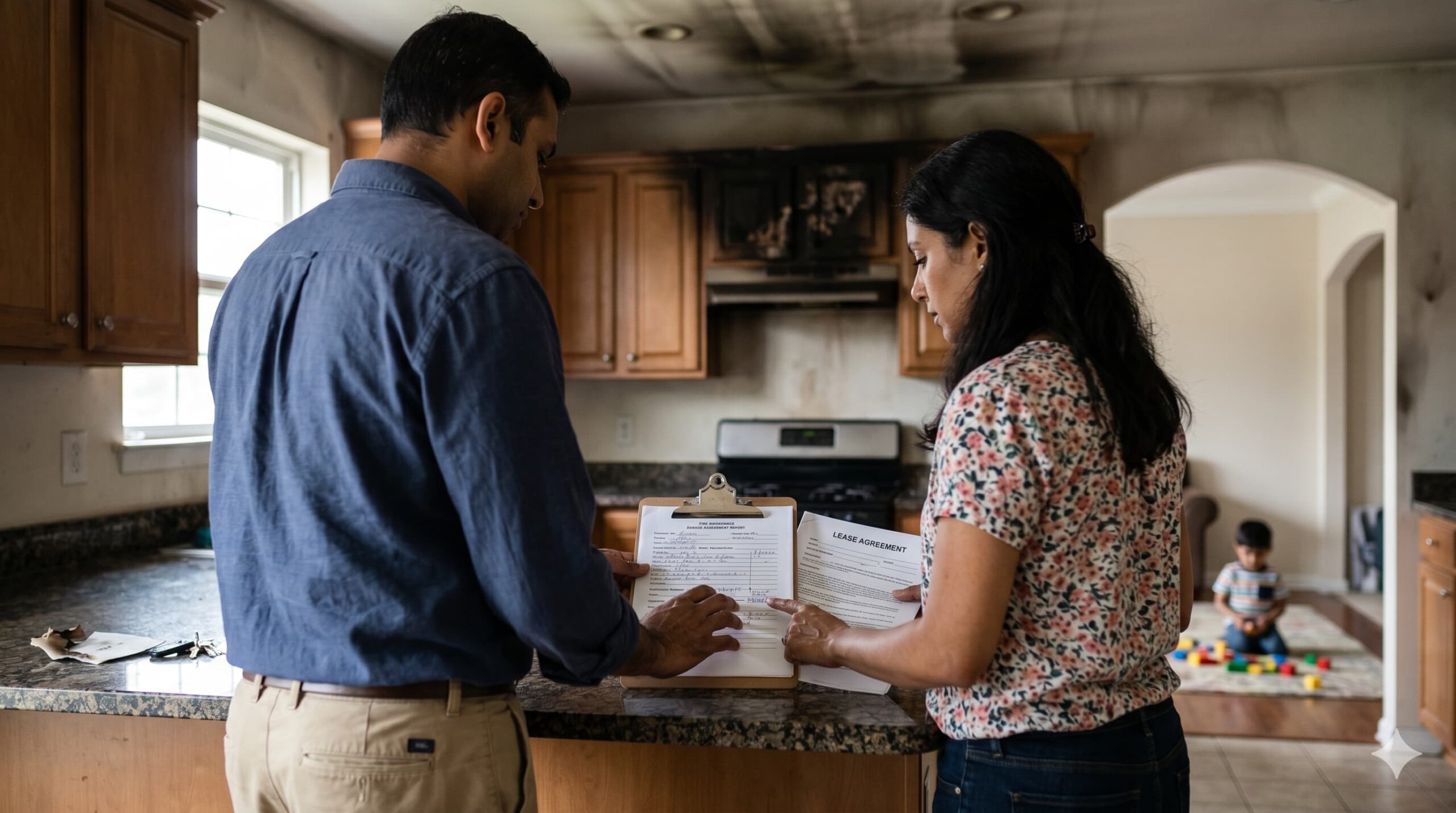
A Charlotte couple bought a new home, rented out their old one to a family friend for $1,850 a month, kept the existing homeowners’ policy in place to save money, and came home ten months later to a kitchen fire, $87,000 in damage, and a denial letter citing the change-of-occupancy clause that voided the policy on day 31. They had paid ten months of premiums on a policy that had not legally existed since the day the tenant moved in.
The Occupancy Clause Every Homeowners Policy Has
Every homeowner’s policy sold in the United States is underwritten on a single foundational assumption: the named insured lives in the home as their primary residence. That assumption is not buried in the fine print. It is the first condition on the declarations page, and it drives everything else about the policy, including the premium, the deductible structure, the liability coverage, and the eligibility rules the carrier used to accept the risk in the first place.
When occupancy changes, the product no longer matches the risk. A homeowner who drives the kids to school and sleeps in the master bedroom is a different underwriting profile than a tenant who pays rent and has no equity stake in the property. Tenants do not maintain homes the same way owners do. They do not catch small leaks early. They do not clean gutters, check smoke detectors, or call a plumber about a drip. Claim data from the National Association of Insurance Commissioners has shown for decades that tenant-occupied single-family homes have a 25 to 40 percent higher claim frequency than owner-occupied homes of the same age and type.
Every homeowner’s policy contains a clause, usually titled “change in occupancy” or “vacancy and occupancy,” that requires the insured to notify the carrier if the home is no longer owner-occupied. Most policies give you 30 days. After that, coverage is suspended or voided for any loss that occurs while the home is tenant-occupied, depending on the carrier. The Charlotte couple hit day 31 on October 12. The fire happened on October 28. The policy had already stopped covering them sixteen days earlier.
HO-3 Versus DP-3, Line by Line
The right product for a rental property is a dwelling fire policy, most commonly a DP-3 form, often called a landlord or rental dwelling policy. The DP-3 looks similar to an HO-3 homeowners policy at first glance, but the coverage structure is built around a different assumption: the owner does not live in the house, and the risks of renting are baked into the premium.
- HO-3 covers the dwelling, other structures, personal property, loss of use, personal liability, and medical payments. The assumption is that the owner and family live there.
- DP-3 covers the dwelling, other structures, fair rental value (lost rent during a covered repair), and landlord liability for tenant injuries. Personal property coverage is limited to landlord-owned items, such as appliances and maintenance equipment.
- HO-3 personal liability protects the family from lawsuits arising from their own activities. DP-3 liability coverage protects the landlord from lawsuits arising from the property’s condition.
- HO-3 loss-of-use pays for temporary housing if the family has to move out after a loss. DP-3 fair rental value pays the landlord the rent they would have collected during the repair period.
Those differences are not cosmetic. A tenant who slips on an icy porch step and sues the landlord has zero coverage under an HO-3, because HO-3 liability covers the named insured’s activities, not the landlord’s exposure. A tenant displaced by a fire whose damaged belongings need to be replaced is covered by the tenant’s own renters insurance, not the landlord’s policy, which is exactly why landlord leases should require proof of renters insurance at signing.
When You Actually Need to Switch, and When You Might Not
The rule is simple. If the home is no longer your primary residence and someone else is living there, you need a landlord policy. The edges get blurry, and that’s where most homeowners get caught.
A family member living rent-free in a home you own is still a change in occupancy under most carrier definitions, even if no lease exists. Some carriers will allow an endorsement on the homeowners policy for up to 12 months of temporary vacancy or family occupancy while you sell the property. Most will not. Call before assuming.
Short-term rentals through Airbnb or Vrbo are a separate category entirely. Most DP-3 landlord policies exclude rentals of less than 30 days, which means a homeowner running a weekend Airbnb needs a short-term rental endorsement or a dedicated commercial short-term rental policy on top of, or instead of, the DP-3. Airbnb’s Host Protection Insurance is secondary coverage only and is riddled with exclusions that come out during claims.
Vacant properties between tenants are the third trap. A DP-3 policy will suspend most coverage after 30 to 60 days of vacancy, which means a landlord who takes three months to find the next tenant has a gap in the middle. A vacancy endorsement or a separate vacant-dwelling policy covers the interim period.
The one situation where you might legitimately keep the homeowners’ policy is a short waiting period between moving out and selling the home, with no tenant occupying the property, typically 30 to 60 days, depending on the carrier. That window is narrow; it has to be disclosed to the insurer, and it ends the moment you sign a lease.
The Cost Math on Switching
The Charlotte couple’s HO-3 policy cost $312 a month, or $3,744 a year, for a home with a $310,000 dwelling coverage limit. A comparable DP-3 landlord policy would have cost roughly $60 more per month, or $720 more per year. That is the entire cost difference between an insured loss and an $87,000 out-of-pocket bill, plus the additional $14,000 in smoke and water damage to the upstairs.
DP-3 policies typically run 15 to 25 percent more than a comparable homeowners policy for the same structure. The higher premium reflects the higher claim frequency of tenant-occupied homes, not carrier opportunism. Fair rental value coverage (typically priced to replace 12 months of rental income after a covered loss) is often included at no extra charge and pays the difference between a fire that makes the house uninhabitable and months of mortgage payments with no rent coming in.
Landlord policies also unlock liability protection that a homeowners policy does not provide once occupancy changes. The tenant’s slip-and-fall claim, the contractor injured during a repair, and the dog bite on the back porch are all landlord liability claims, and none of them have an HO-3 defense.
A quick read of your existing homeowners policy declarations page will tell you whether occupancy is coded as primary, secondary, or rental. If you are still coded as primary and someone else is living there, call the broker this week. While you are at it, recheck your dwelling limit on the rental, because a home that was adequately insured as your primary residence five years ago may now be underinsured at rebuild cost.
Questions to Ask Your Broker Before You Rent
- Is my current homeowners’ policy valid if the home is no longer my primary residence, and how many days of change in occupancy does the policy allow before coverage suspends?
- What is the premium difference between keeping my homeowners policy and switching to a DP-3 landlord policy on the same dwelling limit?
- Does the DP-3 policy include fair rental value coverage, and how many months of lost rent does it pay after a covered loss?
- If I plan to rent short-term through Airbnb or Vrbo, do I need a short-term rental endorsement or a separate commercial policy on top of the DP-3?
- What liability limit does the landlord policy carry for tenant injuries on the property, and is an umbrella policy available to extend it?
Call Before the Tenant Moves In
The Charlotte couple’s mistake was not cheap rent or a bad tenant. Their mistake was assuming that a house insured yesterday would be insured tomorrow when the only thing that changed was who slept in the bedroom. A homeowner’s policy is a product for a specific scenario, and the scenario ends when the owner moves out.
If you are planning to rent out a property this year, make one phone call to your broker before the tenant signs the lease. Ask for a DP-3 quote. Compare it to your current homeowners’ premium. If the monthly difference is under $100 (and it almost always is), make the switch and sleep through the next kitchen fire.
Does your insurer actually know a tenant lives in the house?
A $60-a-month switch to a landlord policy would have covered this $87,000 fire. Compare homeowners and landlord insurance quotes in minutes.
Get Home Insurance Quotes →