5 min read · Last updated May 29, 2026
In this article
- What the earth movement exclusion actually says
- The narrow exceptions and what they actually cover
- Sinkhole, settling, and soil expansion: separate coverage, separate cost
- What to document, what to add, and when to file anyway
- FAQ
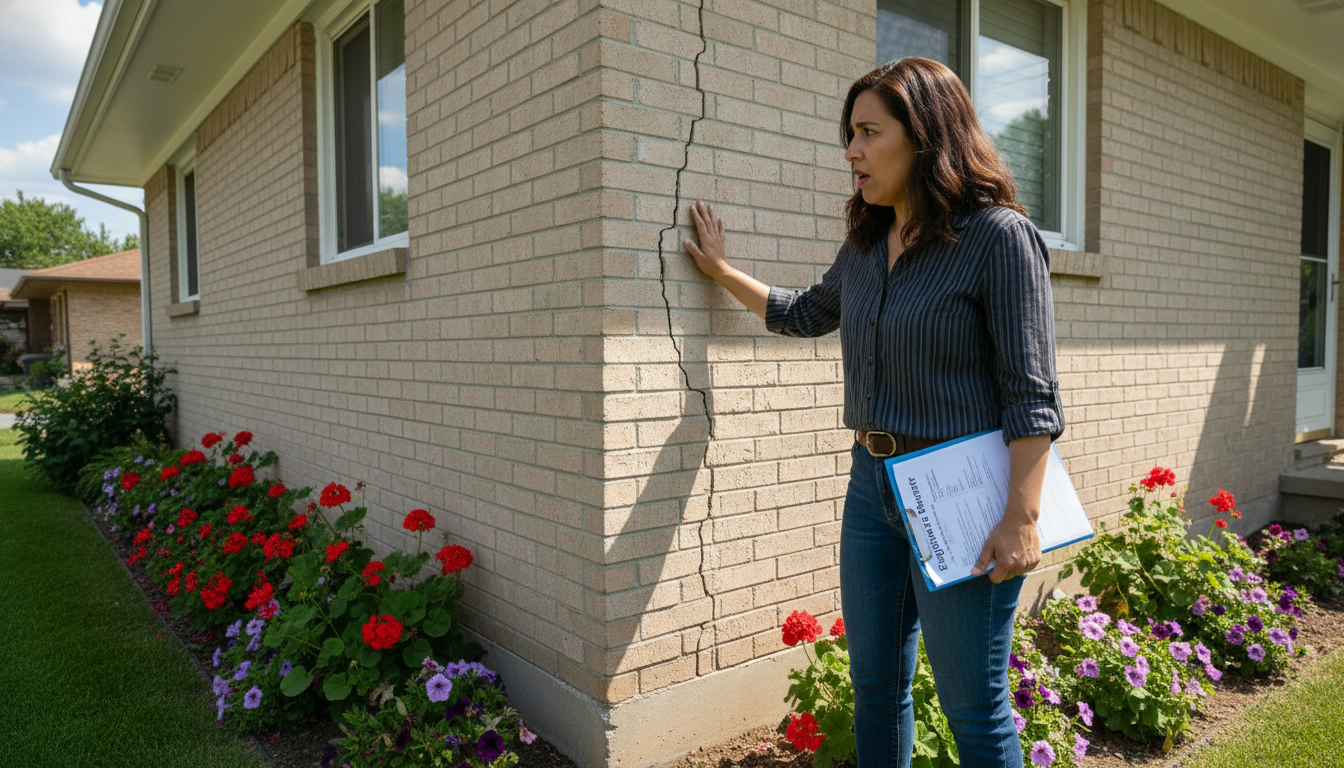
Carmen Delgado, a 38-year-old physical therapist who bought a 1996 ranch home in Houston in 2021, noticed a diagonal crack widening in the sheetrock above her front door in early March. By the time she hired a structural engineer, the crack had grown to three-eighths of an inch and the engineer had traced it to a shifted slab. The repair quote came in at $32,400 for slab piers and interior wall stabilization. Her carrier denied the claim under the earth movement exclusion. The declarations page listed open-perils coverage on the dwelling. The exclusion she had not read carved out settling, soil contraction and expansion, and any form of subsurface earth movement.
What the earth movement exclusion actually says
The standard ISO HO-3 dwelling form (HO 00 03 05 11 and later) and most carrier-proprietary equivalents contain an earth movement exclusion that runs roughly four to seven lines in the policy. The exclusion typically lists earthquake, landslide, mudslide, mudflow, subsidence, sinkhole, and “earth sinking, rising, or shifting.” Many forms extend the exclusion to soil conditions, including expansive soils, contracting soils, and the slow settling of foundations over time.
The breadth of the exclusion is what surprises homeowners. A sudden sinkhole that opens overnight, a slow soil shrinkage from drought, and a settling crack from poorly compacted backfill all fall under the same exclusion. The carrier does not have to prove which type of earth movement caused the loss. It only has to show that some form of earth movement was a contributing cause. Anti-concurrent causation language in the same section of the policy then closes the gap, denying coverage even when a covered peril (such as a leaking water line under the slab) contributed to the loss alongside the excluded earth movement.
The narrow exceptions and what they actually cover
Two carve-outs exist in many forms. Some policies cover ensuing fire or explosion that follows earth movement, so if an earthquake breaks a gas line and the home burns, the fire damage is covered (the earthquake damage is not). Other policies cover glass breakage caused by earth movement, paid under a small sublimit. Neither carve-out covers the foundation, the slab, or the walls cracking from the earth movement itself.
Sinkhole coverage is a separate product in most states. In Florida, Tennessee, and parts of the Southeast, carriers offer a sinkhole loss endorsement that pays for both the structural damage and the cost to stabilize the affected ground. The endorsement runs $200 to $600 a year in most carrier rate filings, with higher pricing in known karst-terrain counties. Earthquake coverage is sold as a separate endorsement or standalone policy. California Earthquake Authority pricing on a $300,000 dwelling runs $800 to $3,500 per year depending on construction type and proximity to active faults.
Sinkhole, settling, and soil expansion: separate coverage, separate cost
Three distinct foundation-failure modes drive most claims, and each has a different coverage path.
| Failure mode | Standard HO-3 covered? | Endorsement available? | Typical annual cost |
|---|---|---|---|
| Sudden sinkhole (catastrophic ground cover collapse) | Florida only (statutory) | Yes, in sinkhole-prone states | $200 to $600 |
| Slow soil expansion or contraction | No | Rare, in expansive-clay regions | $400 to $1,200 |
| Earthquake or fault movement | No | Yes, separate endorsement or standalone | $800 to $3,500 |
| Settling from poor compaction or construction defect | No, also defect exclusion | No, treated as builder issue | Not available |
| Mine subsidence (mining states) | No, but some states offer mandatory program | Yes, through state mine subsidence fund | $30 to $200 |
| Best for | Florida residents, fault-zone residents | Texas, Oklahoma, Carolinas residents | Mining-state residents |
Settling from defective construction or poor compaction is typically excluded both by the earth movement clause and by the policy’s faulty workmanship exclusion. That is the hardest scenario to find any coverage for because the cause of loss is technically a construction defect, not a natural event. Pursuit against the original builder or the seller may be the only recovery path, and the statute of limitations on construction defect claims is typically four to ten years from completion depending on state.
What to document, what to add, and when to file anyway
Before a loss, document the home’s foundation condition every two to three years with a structural engineer’s inspection. The $400 to $900 cost of the inspection produces a paper trail that distinguishes pre-existing settling from new movement after a covered event. Photograph the exterior foundation and any visible interior cracks at the same intervals. The dated photos pair with the engineer’s report if a claim ever happens. Cross-reference the policy’s full exclusion list the next time the renewal arrives. Read it in the same sitting you use to compare homeowners insurance policies for the upcoming term. If the home sits on expansive clay or near a mining district, price out the available endorsements. If flood damage is also a risk on the property, treat each excluded peril as a separate decision with its own endorsement or standalone policy.
If a loss occurs, file the claim even when an exclusion seems to apply. Two paths sometimes recover coverage. The first is showing that a covered peril contributed independently of the earth movement, such as a long-running plumbing leak that softened the soil. Many states’ courts have narrowed anti-concurrent causation language in recent years. The second is showing that the exclusion in your specific form is narrower than the carrier is reading it. The wording differs across carrier-proprietary forms, and a few do not explicitly exclude settling or soil expansion. The exclusion mechanics work the same way for a sewer backup denial, where buying back the coverage requires an endorsement, not a re-reading of the base form. Recovery limits also matter: if the dwelling coverage is short of full rebuild cost, even a covered loss runs short of the actual repair bill.
Earth movement is one exclusion that can sink a foundation claim before the adjuster even reaches the “collapse” question. Even without earth movement in the picture, a cracking or bowing foundation wall that is still standing rarely qualifies as a covered “collapse” under a standard homeowners policy, since most forms pay only for an abrupt falling-in, not gradual structural damage.

Compare home insurance quotes that disclose earth movement and foundation coverage up front.
See which carriers in your state offer sinkhole, earthquake, and soil expansion endorsements and what they price at for your home.
Get home insurance quotesFAQ
Does any standard homeowners policy cover foundation cracks? The standard HO-3 policy does not cover cracks caused by earth movement, settling, soil expansion, or construction defect. A covered cause of loss (such as a vehicle striking the foundation or a tree falling on the wall) can pay for foundation damage caused by that specific event. The slow-moving cracks that account for most foundation claims are excluded.
What is the difference between earth movement and earthquake coverage? Earth movement is the broader policy exclusion that covers earthquake, landslide, mudslide, sinkhole, and gradual subsurface shifting. Earthquake coverage is a separate endorsement (or standalone policy in California through the California Earthquake Authority) that buys back only the earthquake portion of the exclusion. Buying earthquake coverage does not restore coverage for sinkhole, settling, or soil expansion.
Is sinkhole coverage included in any state’s homeowners policy by default? Florida is the only state where a minimum level of sinkhole-related coverage (called “catastrophic ground cover collapse” coverage) is statutorily required in every homeowners policy. Tennessee carriers offer a sinkhole loss endorsement that is not automatic. Every other state requires the policyholder to add sinkhole coverage by endorsement or skip it.
Can a homeowner sue a builder for foundation defects the insurance company will not cover? Yes. Construction defect claims against builders, foundation subcontractors, soil engineers, or sellers exist in most states. The statute of limitations typically runs four to ten years from substantial completion of the home, and some states require pre-suit notice and a chance to repair. Recovery depends on the original builder still being solvent and bonded, and on the defect being traceable to a specific construction error rather than to soil conditions.
How much does foundation repair typically cost? Steel push piers driven to load-bearing strata run $1,200 to $2,800 per pier with eight to twenty piers commonly needed, putting most slab-pier projects in the $12,000 to $38,000 range. Crawl-space and basement repairs vary widely by depth and access, ranging from $4,000 for minor wall stabilization to over $50,000 for full underpinning. Hydraulic mudjacking on a settled slab section runs $500 to $1,500 per area.