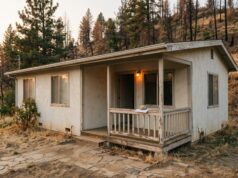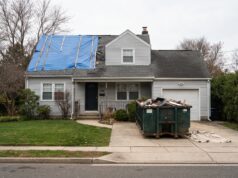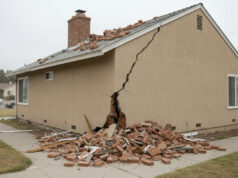
Aisha bought a 1962 brick colonial in suburban Detroit in 2019 for $245,000. In November 2024 a kitchen grease fire spread to the second floor before the fire department contained it. Damage to the structure came in at $128,000. Her homeowners insurance approved the claim and paid for the kitchen, the floor above, and the smoke remediation. Then the city building inspector posted a stop-work order on the rebuild. The fire had affected more than 25 percent of the structure, which under the local code triggered a full-house upgrade requirement: hardwired interconnected smoke detectors, current electrical wiring throughout, a new GFCI plumbing layout, and asbestos abatement on the original popcorn ceilings. The contractor’s estimate for the code upgrades alone was $87,400. Aisha’s standard homeowners policy did not cover any of it. She had no ordinance or law endorsement.
The gap between repair and code compliance
Standard homeowners policies, including HO-3 and HO-5 forms, pay to restore the damaged portion of a home to its pre-loss condition. They do not pay for code-required upgrades to undamaged portions of the home, and they do not pay the cost difference when modern materials and methods cost more than the original construction. The policy language is clear, and most homeowners never read it.
Local building codes have changed significantly since the 1960s, 1970s, and 1980s when many of the homes in the United States were built. Electrical service has moved from 60 amp to 200 amp panels. Plumbing risers no longer use galvanized steel. Smoke detectors are required to be hardwired and interconnected throughout the home. Lead paint and asbestos abatement protocols apply to any disturbance of original materials. When a partial loss exceeds 25 to 50 percent of the structure, the threshold varying by jurisdiction, the entire home must be brought to current code, not just the damaged portion.
The Insurance Information Institute estimates that code upgrade costs add 15 to 50 percent to the total restoration cost for homes built before 1990, depending on the jurisdiction and the depth of the upgrade. On Aisha’s claim, the upgrade cost was 68 percent of the structural damage figure.
What ordinance or law coverage does
The endorsement adds three coverage components to the policy. Coverage A pays the increased cost to repair or replace the damaged portion of the home using current code-compliant materials and methods. Coverage B pays the cost to demolish and remove the undamaged portion of the home if the local code requires it. Coverage C pays the increased construction cost to bring the undamaged portion of the home up to current code.
Most insurers offer ordinance or law coverage as a percentage of the dwelling limit, ranging from 10 to 50 percent. A home insured for $400,000 with a 25 percent ordinance or law endorsement carries $100,000 of additional code-upgrade coverage. The premium for the endorsement runs $50 to $250 a year for the typical single-family home, depending on age and jurisdiction.
How much coverage to buy
The right limit depends on three factors: the age of the home, the depth of the local building code’s upgrade requirements, and the percentage threshold that triggers a full code upgrade. Homes built before 1980 in jurisdictions with strict upgrade triggers should carry at least 25 percent of the dwelling limit in ordinance or law coverage. Homes built between 1980 and 2000 typically need 10 to 15 percent. Homes built after 2000 in jurisdictions with grandfathering provisions can often carry the minimum 10 percent.
A current building code review with a local contractor before renewing is the most accurate way to size the limit. Ask the contractor what would have to change about the home’s electrical, plumbing, structural, and life-safety systems if 30 percent of the structure had to be rebuilt today. The dollar number from that exercise is the floor on the ordinance or law limit.
For a related coverage decision, see how to compare homeowners insurance policies and what to do when your dwelling coverage is too low.
What it does not cover
The endorsement covers code upgrades triggered by a covered loss. It does not pay for routine code upgrades you elect to do during a renovation. It does not cover excluded perils, which means flood-driven code upgrades require a separate flood policy with its own ordinance or law component. For more on the flood gap, see the flood coverage exclusion most policies hide.
It also does not pay for losses where the local jurisdiction grants a variance and waives the code upgrade. If the city allows the home to be rebuilt to its original 1965 specs, no ordinance or law coverage applies because there is no increased cost to insure.
What to ask the agent at renewal
Three questions move ordinance or law from a hidden gap to a sized line item. What is the current ordinance or law endorsement on the policy, expressed as a percentage of the dwelling limit. What is the local building code threshold that triggers a full-house upgrade. What is the contractor’s estimated cost to bring the home up to current code if 30 percent of the structure had to be rebuilt today. The agent who has not had this conversation will not have the answers, and that is the signal to push for the endorsement.
FAQ Section
Does my standard homeowners policy include any code upgrade coverage? A small amount, usually 10 percent of the dwelling limit, is included by default on HO-3 and HO-5 forms. For homes built before 1990, the included amount is rarely sufficient and the gap between included coverage and actual upgrade cost has to be paid out of pocket.
Is ordinance or law coverage the same as building code upgrade coverage? Yes. Carriers use both terms interchangeably. The endorsement language varies, but the coverage trigger and the three component coverages (A, B, C) are standardized across most major insurers.
Will the endorsement pay for upgrades I do during a normal renovation? No. The coverage only triggers when a covered loss requires the upgrade. Voluntary remodeling, deferred maintenance, and elective improvements are not covered. The trigger is a claim, not a permit.
Can I add ordinance or law coverage mid-policy or only at renewal? Most carriers allow it mid-policy through an endorsement. Some require renewal. Either way, get the increase in writing and confirm the effective date before relying on the additional coverage.
Does the endorsement apply to the contents of the home? No. Ordinance or law coverage applies only to the dwelling structure and other structures (Coverage A and Coverage B on the policy). Personal property is covered under Coverage C of the policy and is not affected by code upgrade requirements.
Closing
A 25 percent ordinance or law endorsement on a $400,000 home costs roughly $150 a year. The coverage gap it fills runs $20,000 to $100,000 on a typical partial loss in an older home. The premium math is one of the cheapest moves in homeowners insurance, and the carrier rarely volunteers it at renewal. Ask. Buy the endorsement at the right limit. The next time the city building inspector posts a stop-work order, the policy will pay.
Compare homeowners insurance with ordinance or law coverage
See real coverage options for older homes, code upgrades, and dwelling replacement cost. Free comparison, no obligation.
Get Homeowners Insurance Quotes