7 min read · Last updated November 26, 2026
- A standard renters policy’s off-premises theft provision covers a package stolen from your porch, not just items stolen from inside your unit.
- That coverage carries its own dollar limit. The Insurance Information Institute’s own example: a $25,000 personal-property limit caps off-premises theft reimbursement at $2,500, or 10% of the total.
- Most renters policies carry a $500 or $1,000 deductible. A stolen item worth less than your deductible pays $0 if you file, no matter how clearly it is covered.
- Credit card purchase protection, when your card has it, is usually secondary coverage, meaning it is meant to pick up after your other insurance. In practice that often makes it the only check you actually get for a low-value loss.
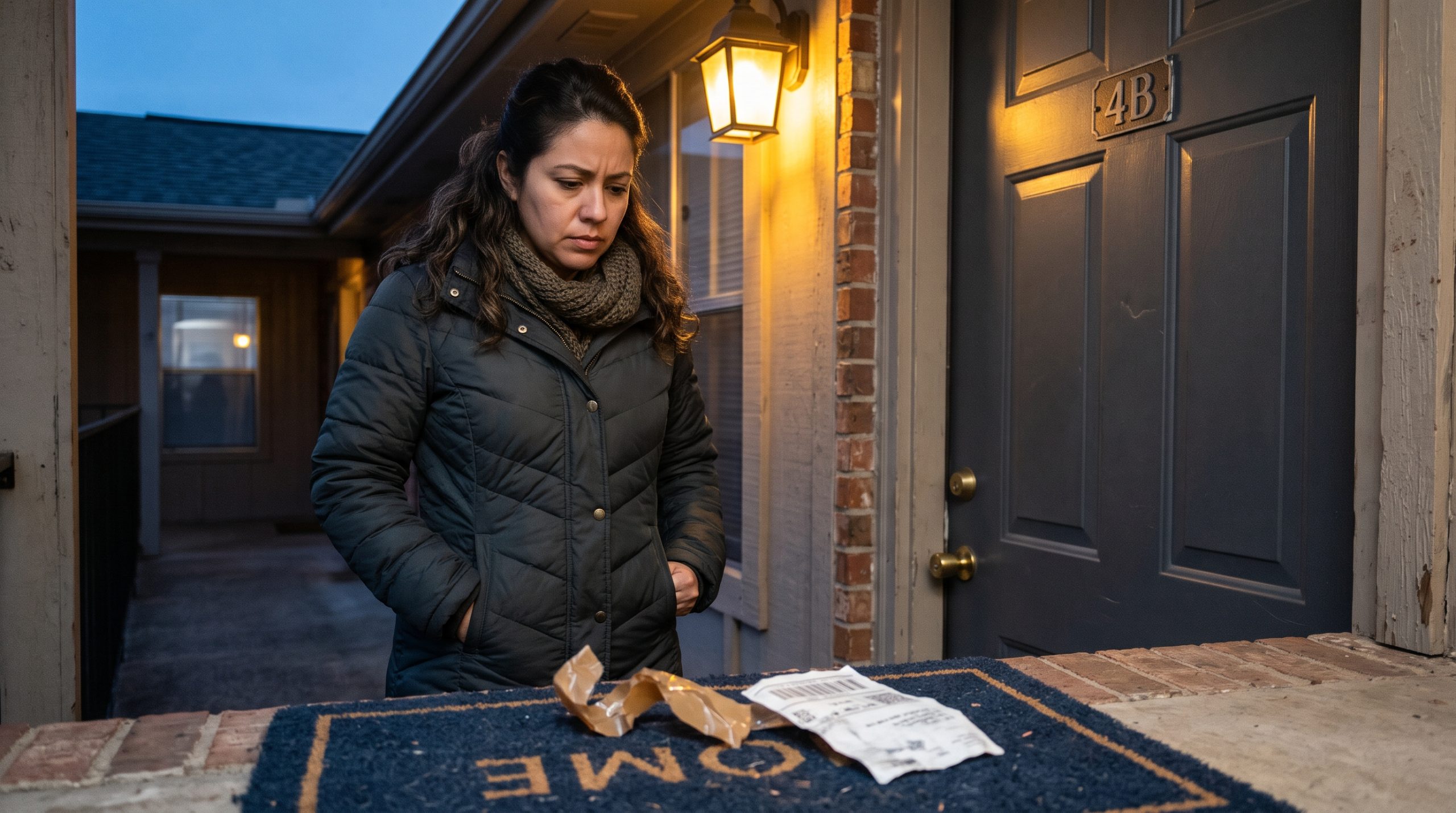
A stolen porch delivery is usually a covered loss under your renters policy. It is covered under the same off-premises theft provision that pays out if someone breaks into your car, and the payout on a low-value package is routinely $0 once the deductible is subtracted. Say a $180 pair of boots goes missing sometime between the delivery scan and the moment you walk up the steps: the coverage answers that claim without a fight, and the check at the end of the process is for nothing at all.
Why a stolen package falls under “off-premises” coverage
Renters insurance does not need a special rule for porch theft. The standard renters form, built around the Insurance Services Office’s HO-4 policy language, already extends personal-property coverage to belongings outside your unit, not just what is inside four walls.
The Insurance Information Institute describes it plainly: most renters policies include “off-premises coverage,” meaning belongings outside your home are covered against the same risks named in your policy, theft included. Property stolen from your car is the Institute’s own example, and a package sitting on your porch is the same category of loss: it belongs to you, it is outside your unit, and it was taken by theft.
That coverage comes with its own ceiling, separate from your overall personal-property limit. The Institute’s worked example: a renter carrying $25,000 in personal-property coverage is capped at $2,500 for an off-premises theft claim, or 10% of the total policy limit.
A renter carrying $15,000 in coverage is working with a $1,500 off-premises ceiling instead. The cap exists because insurers price “stuff inside your locked apartment” differently than “stuff that was, at some point, sitting outside unattended,” and a package on a porch is squarely the second category. It is the same instinct that puts a separate, tighter dollar cap on jewelry stolen from a rental unit: the policy still answers the claim, it just answers it inside a smaller box than your headline coverage number suggests.
The deductible math that actually decides the claim
Coverage existing is not the same question as a claim paying anything. Every renters policy carries a deductible, the amount you cover yourself before the insurer pays a cent, and the Institute’s own guidance puts the common starting point at $500, with $1,000 available on most policies for a meaningful premium discount. Run the arithmetic on a typical stolen holiday delivery:
A $180 pair of boots disappears from the porch between the delivery scan and the moment you get home. Your policy’s off-premises theft provision covers it. Your deductible is $500.
The claim math is $180 minus $500, which does not go negative; it floors at $0. You would file a police report, wait on an adjuster, and answer questions about the loss, and the check at the end is for nothing, because the loss never cleared the amount you agreed to absorb yourself.
The breakeven point is simple to find for your own policy: a stolen item only produces a payout once its value exceeds your deductible. At a $500 deductible, a $650 item nets $150. At a $1,000 deductible, that same $650 item nets $0.
The Institute is direct about that cost: “you’ll pay the deductible each time you file a claim,” and raising a deductible from $500 to $1,000 can knock as much as 25% off the policy’s premium, which is the insurer’s own signal for how much it wants to avoid processing small claims in the first place.
What to actually try, in order
Before any insurance enters the picture, start with the party that shipped the box. Most retailers and carriers will reship or refund a package that never should have been left unattended in the first place, or one that genuinely went missing in transit, separate from a package that scanned as correctly delivered and was then taken off the porch.

That second category is the one every retailer and shipping company treats as out of their hands the moment the delivery photo or scan confirms the drop-off, which is why it becomes a theft claim against your own coverage rather than a shipping dispute against theirs. A police report helps every step that follows, even a short, non-urgent one filed online, because every later party in line (the retailer, the card issuer, your own insurer) will ask for it before paying anything, and having it ready before you call speeds up every one of those conversations.
If the retailer and carrier decline, a credit card’s purchase protection benefit is usually the next move, and it is frequently the one that actually pays for a low-value loss. Experian’s guide to the benefit confirms the typical shape: coverage for new items that are stolen or damaged within 60 to 120 days of purchase, varying by card issuer, and explicitly structured as secondary coverage, meaning “it can only be used after you’ve exhausted all of the other coverage you have available,” renters insurance named as one of the examples. In practice, that requirement is easy to satisfy on a below-deductible loss: your renters policy’s own payout is $0, which is exhausting that coverage in every sense that matters, and the card issuer’s claim moves forward from there.
Renters insurance is the move of last resort, reserved for the loss big enough to survive the deductible: a laptop, a phone, a coat with real resale value. Below that line, the retailer and the card issuer are doing the real work, and the policy you pay for every month is sitting this one out. December is the month this sequence gets tested the most, simply on volume: more packages sit on more porches for longer stretches of the day, and the same deductible math applies whether the box went missing in July or the week before a holiday.
| Option | Typical deductible or waiting period | Typical limit | Best for |
|---|---|---|---|
| Retailer or shipping carrier claim | None, but only applies before confirmed delivery or on a carrier error | Full replacement or refund | A package lost, misdelivered, or never actually left on your porch |
| Credit card purchase protection | None (secondary coverage, applies after other insurance) | Varies by card, commonly $500 to several thousand dollars per claim | A correctly delivered item stolen within 60 to 120 days of purchase |
| Renters insurance off-premises theft | Your policy deductible, commonly $500 to $1,000 | 10% of your personal-property limit (Institute example: $2,500 on a $25,000 policy) | A loss well above your deductible, not a single low-value package |
Frequently asked questions
Does renters insurance cover a package stolen from outside my door? Yes, under the off-premises theft provision most renters policies include. The loss is treated the same as property stolen from your car, subject to a lower dollar cap than your in-unit coverage and your regular deductible.
Why would my insurer deny a claim for a stolen package I can prove was delivered? It is rarely a denial. More often the claim is approved and pays $0, because the item’s value sits below your deductible. Coverage existing and a claim paying out are two different questions.
Should I still file a police report if the stolen item is low value? Yes. A report costs nothing, takes a few minutes online in most cities, and every other party in line, the retailer, the carrier, your card issuer, will ask for one before they pay anything.
Does filing a small renters insurance claim affect my future premium? It can. Insurers price renters policies partly on claims history, and a paid claim, even a small one, can follow you at renewal. That is part of why a loss under your deductible is worth skipping rather than filing anyway.
What deductible should I choose if porch theft is my main worry? A higher deductible saves money every month but guarantees more low-value losses, package theft included, pay nothing. A lower deductible costs more monthly but clears more small claims. Match the choice to how often you expect a loss in the $200 to $600 range, not to the rare large loss.
Check what your own policy actually covers off-premises
Compare renters insurance quotes and see your real off-premises limit and deductible before the next delivery goes missing.
Compare Renters Insurance Quotes