8 min read · Last updated November 25, 2026
- A standard business income form pays only for lost income caused by direct physical loss or damage at your own described premises, not damage to a utility’s equipment somewhere else.
- Even when an insurer agrees the outage came from a covered cause, the standard business interruption forms carry a stricter exclusion for utility failures that happen “outside of a covered building.”
- Two separate endorsements close the gap: Utility Services – Direct Damage pays for spoiled stock or damaged equipment, and Utility Services – Time Element pays for the lost income itself.
- Coverage for overhead transmission lines is often excluded by default inside those endorsements, especially in regions highly susceptible to windstorms, and has to be requested and scheduled separately.
Business income insurance usually will not pay for a power outage caused by damage to a transmission line, substation, or transformer that sits away from your own building. The policy’s trigger is physical damage at your described premises, and a dark storefront with an intact roof and walls rarely meets it without a separate endorsement.
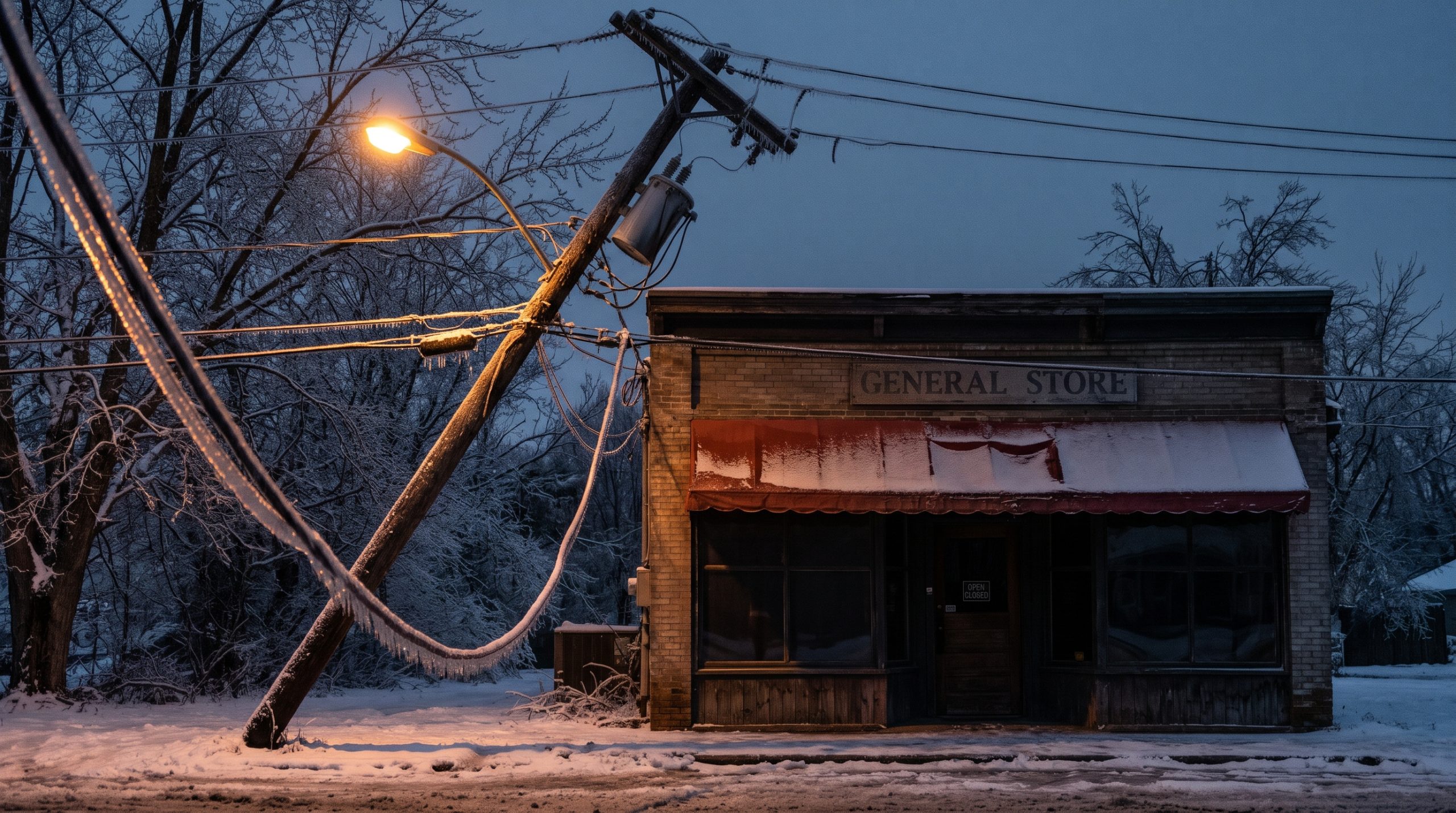
Say a retailer closes for four straight days after a regional ice storm snaps an overhead line a few miles from the store.
Nothing on the property itself is damaged. The freezer holds spoiled stock, the registers sit dark, and four days of revenue are gone. The business owner files a business income claim expecting it to behave like any other covered loss, and the insurer denies it on the utility services exclusion.
Why the standard form requires damage you can see
The Insurance Services Office (ISO) Commercial Property (CP) program’s Business Income coverage form states the trigger directly. As a legal analysis of power-outage coverage published in the Journal of Insurance Coverage quotes the form, the insurer will pay for the actual loss of business income sustained “due to the necessary suspension of your ‘operations’ during the ‘period of restoration’.”
“The suspension must be caused by direct physical loss or damage to property…at premises which are described in the Declarations…” The loss or damage has to result from a covered cause of loss, and it has to happen at the insured’s own location, or within 100 feet of it in the case of personal property in the open.
That single sentence is the whole problem for an off-premises outage. A transformer explosion three blocks away, a tree falling on a transmission line, or a substation flooding do not damage anything described in the declarations. The building is fine, and only the income is gone.
The exclusion that survives even when the cause of loss is covered
Commercial property policies also carry a standard off-premises services exclusion, which the same analysis of the ISO forms describes as barring coverage for loss caused by “the failure of power or other utility service supplied to the described premises, however caused, if the failure occurs away from the described premises,” with an exception if that failure itself goes on to cause a covered loss, like a resulting fire. For a straightforward power outage, that exception rarely applies, since there is no secondary covered event to point to.
What makes the gap harder to spot is that the Business Income and Extra Expense forms are actually written to skip that particular exclusion and use a different one instead, one that the same source shows only blocks coverage for a utility failure that happens “outside of a covered building.” In practice this changes almost nothing for a typical outage: if a windstorm takes down a line on the insured’s own property, the resulting physical damage is covered because it originated on-site, but the lost income from the outage itself is still excluded, because the failed equipment sat outside the building. Move the same downed line a quarter mile away and the result is identical. For a cyber incident, the base commercial policy applies a similar logic, and the lost-income portion of a claim only starts once a separate waiting period has run.
The two endorsements that actually pay, and what each one covers
Two optional ISO endorsements are built specifically to restore coverage for an off-premises utility failure, and they split the loss into two distinct pieces rather than fixing it with one form.
The Utility Services – Direct Damage endorsement pays for physical loss or damage to covered property at the insured’s own premises, such as spoiled inventory or equipment damaged by a power surge, when that damage results from a covered cause of loss interrupting a utility service scheduled in the endorsement, and both endorsements are described in the same legal analysis alongside their real-world claims applications. The Utility Services – Time Element endorsement is what actually answers the lost-income question: that source quotes it as stating the insurer “will pay for loss of Business Income or Extra Expense at the described premises caused by the interruption of service to the described premises,” where the interruption itself results from direct physical loss or damage to the scheduled utility property, even though that property sits “outside of a covered building.”
| Coverage | What triggers it | What it pays | Overhead transmission lines |
|---|---|---|---|
| Base Business Income form | Direct physical loss or damage at the insured’s own described premises | Lost income and extra expense during the period of restoration | Not applicable; location is on-site |
| Utility Services, Direct Damage | Covered cause of loss damages a scheduled utility service off-site | Physical loss to the insured’s own property, such as spoiled stock or damaged equipment | Often excluded unless specifically scheduled |
| Utility Services, Time Element | Same off-site utility damage, applied to lost operations | Lost business income and extra expense from the resulting outage | Often excluded unless specifically scheduled |
Both utility endorsements are scheduled by type of service (water supply, communication supply, and power supply are each chosen separately), so a business that only needs power coverage is not forced to buy all three.
The transmission-line catch most policyholders never check
Even after a business buys one or both utility endorsements, the schedule itself often separately excludes overhead transmission lines from the definition of covered utility property, and trade-press guidance for agents confirms many carriers do not include that coverage automatically, especially in regions highly susceptible to windstorms. Getting full protection against an ice storm snapping an overhead line a few blocks away means specifically requesting and scheduling that coverage, not just buying the endorsement and assuming it is included.

A business that adds the Utility Services – Time Element endorsement but leaves overhead transmission lines unchecked on the schedule can still be denied the exact claim the endorsement was bought to cover. A similar scheduling gap shows up on the property side when goods leave the building entirely and a standard policy stops following them.
This gap is also why it belongs in the same conversation as rate trends. Commercial property renewal rates rose 5.65% in the third quarter of 2026, according to the Ivans Index, continuing to ease from 6.40% in the second quarter, but Ivans’ own October monthly print shows commercial property moving the opposite direction of every other line it tracks: the rate ticked up to 5.37% that month, up from 5.11% in September. A line that is quietly re-pricing upward is exactly the moment to confirm a schedule actually includes the coverage a renewal premium is paying for, rather than assuming it carried over unchanged.
Checking your own declarations page
The fix does not require a new policy. It requires reading the schedule on an existing one.
Pull the declarations page and look for a Utility Services – Direct Damage or Utility Services – Time Element endorsement; if neither is listed, the business has no off-premises utility coverage at all. If one is listed, check which services are scheduled (water, communication, power) and whether overhead transmission lines are marked as included or excluded on that schedule.
An agent can usually add or adjust this at renewal for a modest additional premium, well before the next ice storm makes the gap expensive to discover.
Frequently asked questions
Does business income insurance cover a power outage caused by a storm? Only if the outage results in direct physical loss or damage at your own described premises, or if you have added a Utility Services endorsement. A storm that damages a transmission line or substation away from your building typically will not trigger the standard business income form on its own.
What is the difference between Utility Services – Direct Damage and Utility Services – Time Element? Direct Damage pays for physical property loss at your location, such as spoiled inventory, caused by an off-site utility interruption. Time Element pays for the resulting lost business income and extra expense. Many businesses need both, since one addresses property and the other addresses revenue.
Are overhead power lines automatically covered under a Utility Services endorsement? Not always. Carriers frequently exclude overhead transmission lines from the endorsement’s own property schedule by default, especially in regions highly susceptible to windstorms, and the coverage has to be specifically requested and added to the schedule.
Does a Businessowners Policy have the same utility coverage gap? A Businessowners Policy (BOP) builds in property and business income coverage using the same direct physical loss standard as a standalone Commercial Property policy, and it uses its own version of the utility services endorsements to close the identical off-premises gap. The fix is the same either way: check the schedule, not just the limit.
Compare commercial insurance quotes before your next renewal