8 min read · Last updated November 24, 2026
- A standard homeowners (HO-3) policy’s freeze exclusion, form HO 00 03 04 91 from the Insurance Services Office (ISO), “applies only while the dwelling is vacant, unoccupied or being constructed,” not to every pipe that bursts from cold.
- Once a home is vacant or unoccupied, the policy requires “reasonable care”: either maintained heat in the building, or the water supply shut off and the system drained.
- A federal court in Washington state, Hill v. Farmers Property and Casualty Insurance Co., decided March 11, 2026, granted the insurer summary judgment after records showed the thermostat still reading 40 degrees even after the homeowner raised it to 50, with no follow-up check.
- Repairing the burst pipe section is typically the homeowner’s own maintenance cost; the water damage the burst caused to floors, walls, and furnishings is what the policy pays for, according to one major insurer’s own guidance.
In this article
- When the frozen pipe freeze exclusion actually applies
- What a court actually weighed to decide “reasonable care”
- Why the burst pipe itself and the water damage get paid differently
- Frequently asked questions
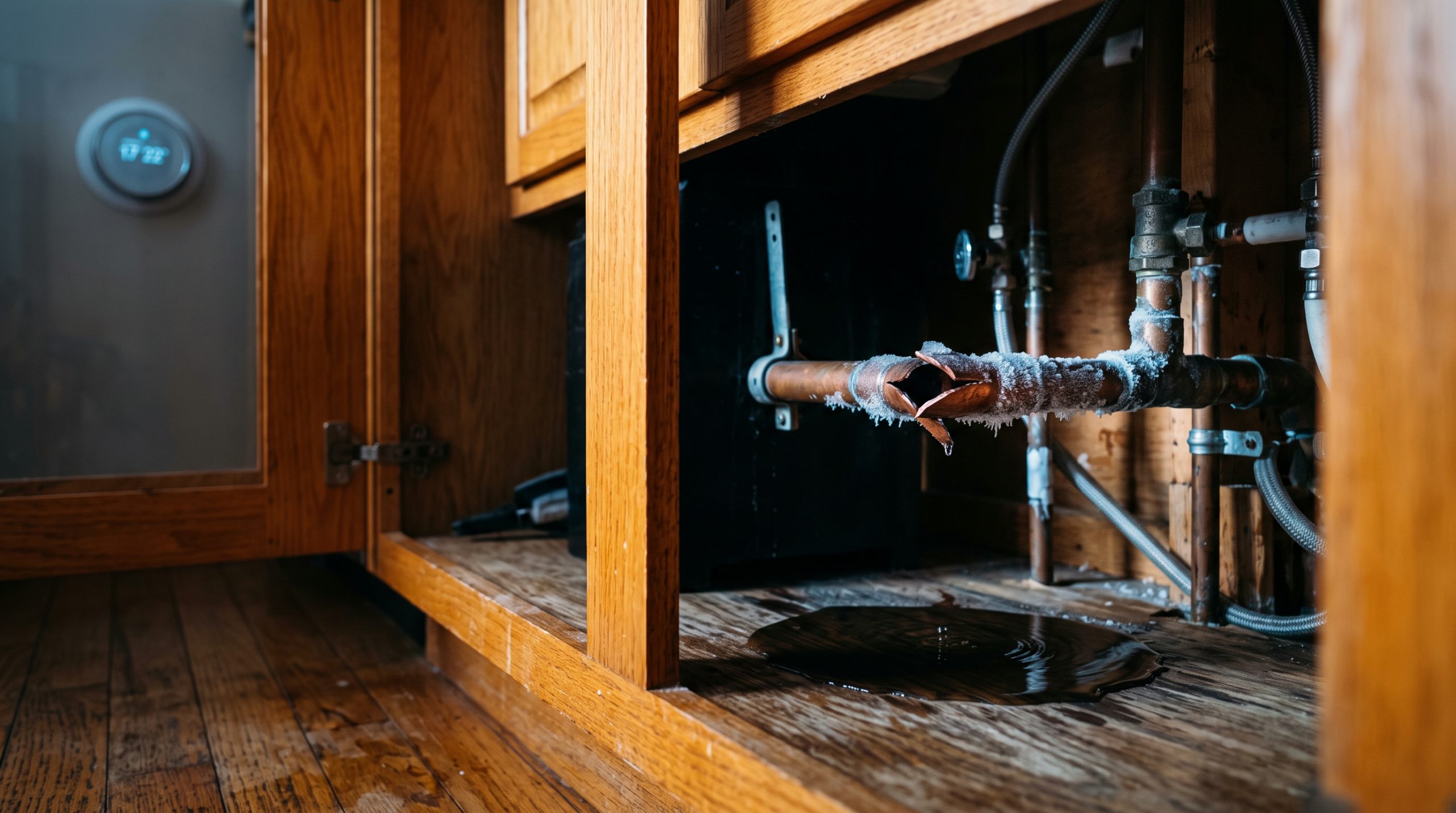
A homeowners policy’s freeze exclusion only applies while the home is vacant, unoccupied, or being constructed. The standard ISO HO 00 03 04 91 form states the exclusion “applies only while the dwelling is vacant, unoccupied or being constructed,” which means a pipe that bursts from cold in a home someone is actually living in generally isn’t excluded in the first place.
A 2026 federal court case out of Washington state shows exactly what the policy demands once a home crosses into “unoccupied.”
When the frozen pipe freeze exclusion actually applies
The same ISO form repeats the occupancy condition in two places, worded slightly differently depending on which coverage is at stake. The Section I exclusion, which governs the dwelling and other structures, reads: “Freezing of a plumbing, heating, air conditioning or automatic fire protective sprinkler system or of a household appliance, or by discharge, leakage or overflow from within the system or appliance caused by freezing. This exclusion applies only while the dwelling is vacant, unoccupied or being constructed, unless you have used reasonable care to: (1) Maintain heat in the building; or (2) Shut off the water supply and drain the system and appliances of water.”
The named-peril version covering personal property reads almost identically: “This peril does not include loss on the ‘residence premises’ while the dwelling is unoccupied, unless you have used reasonable care to: (1) Maintain heat in the building; or (2) Shut off the water supply and drain the system and appliances of water.” Either way, the occupancy status at the time of loss is what decides whether “reasonable care” has to be proven at all.
| Occupancy status at time of loss | Does “reasonable care” apply? | What the policy requires |
|---|---|---|
| Occupied, lived in daily | No, the exclusion states it “applies only while the dwelling is vacant, unoccupied or being constructed” | Nothing extra; the freeze loss isn’t excluded on occupancy grounds |
| Vacant, unoccupied, or under construction | Yes | Maintained heat in the building, or the water supply shut off and the system drained |
What a court actually weighed to decide “reasonable care”
A real case shows how this plays out when a loss actually happens. In Hill v. Farmers Property and Casualty Insurance Co., No. 2:25-CV-0048-TOR (E.D. Wash., decided Mar. 11, 2026), a duplex sat empty while its tenants were away, with temperatures dropping as low as -10 degrees.
The homeowners had agreed to monitor the property, but a furnace filter flagged as clogged months earlier was still clogged when the pipes froze and burst. The court’s own order records that during one visit, “the thermostat indicated the temperature was still forty degrees even though Mr. Hill had raised the thermostat to fifty degrees.” Natural gas usage records for that stretch showed usage equivalent only to a water heater’s pilot light, nothing close to an active furnace, from mid-October until the loss three months later.
The court’s own standard, quoted directly from its order: reasonable care “is that degree of care which the reasonably prudent person would exercise in the same or similar circumstances,” an analysis normally left to a jury unless, in the court’s words, “reasonable minds could not differ.” Based on the insurer’s evidence, an unrebutted expert opinion, and the homeowners’ own admissions, the court concluded the homeowners did not use reasonable care in maintaining heat, and granted the insurer summary judgment.
The homeowners separately argued that a mechanical furnace malfunction, not the freezing itself, caused the loss, hoping that would fall under the policy’s coverage for an ensuing loss instead of the freeze exclusion. The court rejected that too, since the same policy’s own mechanical-breakdown exclusion would have barred the claim either way.
What the court actually weighed is the useful part for anyone managing a property through winter: a prior maintenance notice that was never acted on, an observed-but-ignored thermostat reading, and utility records that contradicted the claim of continued heating. None of those are things an adjuster has to take your word on; they’re the kind of record a utility bill, a smart-thermostat log, or a maintenance invoice either supports or contradicts.
Nothing about this reasoning is specific to a duplex with absent tenants: a second home between visits, a rental unit sitting between tenants, or a house mid-renovation all meet the same “vacant or unoccupied” trigger, facing the identical reasonable-care question if a pipe froze while nobody was checking on them.
A standard homeowners policy treats “vacant” as its own separate condition that reaches well beyond freeze claims, so the same occupancy status driving this exclusion can affect other coverage on the same policy too. The further a property sits from someone’s daily attention, the more that documentation ends up mattering.
Why the burst pipe itself and the water damage get paid differently
Travelers’ own consumer guidance draws a practical line that the ISO form itself doesn’t spell out as a separate clause: “Accidental water damage that occurs as a result of a sudden, unexpected occurrence like a burst pipe is often covered… cleaning, repair or replacement of wood flooring, drywall and even furniture due to water damage as a result of a burst pipe typically is covered.” The same page adds, “Pipe and appliance maintenance falls under the homeowner’s responsibility.” In practice, that usually means the water damage a burst pipe causes gets paid as a covered loss, while replacing the actual pipe section is treated as ordinary upkeep.
This is not a small problem nationally. State Farm’s own claims data shows that from January 2024 through June 2025, the company received more than 20,000 freeze-related claims, including burst pipes and other cold-weather water damage, totaling over $628 million in paid losses, with an average claim payment exceeding $30,000. Illinois, Oregon, Washington, Texas, and Tennessee carried the highest total claim costs.
An average claim above $30,000 puts freeze damage among the costliest common homeowners losses there is, which is exactly why an insurer scrutinizes the “reasonable care” condition closely whenever a home sat empty when the pipes froze, rather than waving the claim through on the strength of the dollar figure alone.
That same guidance also names a specific number worth planning around: Travelers recommends you “set your thermostat to a minimum of 55° when you’ll be away from home,” and to arrange for someone to check on the property if you’ll be gone for an extended stretch. That 55-degree figure is one insurer’s own recommendation, not a number written into every policy, so confirm with your own carrier rather than treating it as a universal rule. Plumbing failures from cold are only one path to a water-damage claim; a buried sewer lateral failing underground is a different mechanic entirely, and usually needs its own separate endorsement rather than anything in the freeze condition above.
Frequently asked questions
Does homeowners insurance cover a burst pipe if someone was living in the house? Generally yes. The standard HO-3 freeze exclusion applies only while a dwelling is vacant, unoccupied, or being constructed, so a pipe that bursts from cold in an occupied home typically isn’t excluded on occupancy grounds at all.
What counts as ‘reasonable care’ to avoid a frozen-pipe claim denial? The policy gives two options once a home is vacant or unoccupied: maintaining heat in the building, or shutting off the water supply and draining the system and appliances of water. Either one satisfies the condition.
What does an insurer actually look at to decide whether reasonable care was used? A 2026 federal court case weighed a prior maintenance notice that went unaddressed, a thermostat reading the homeowner had seen and ignored, and utility usage records that contradicted a claim of continued heating. These are documented facts, not assumptions.
Does homeowners insurance pay to fix the burst pipe itself, or just the water damage? Typically just the water damage. One major insurer’s own guidance states that pipe and appliance maintenance falls under the homeowner’s responsibility, while the cleanup and repair of flooring, drywall, and furniture from the water itself is usually a covered loss.
What temperature should I set my thermostat to if a home will be empty in winter? One major insurer recommends a minimum of 55 degrees, plus arranging for someone to check the property during an extended absence. That figure is one carrier’s own guidance rather than a universal policy requirement, so confirm the specifics with your own insurer.
Compare homeowners insurance coverage before winter weather hits
See what your policy actually requires before you leave the house empty.
Compare Homeowners Insurance Options