7 min read · Last updated November 24, 2026
- State Farm’s newest data counts more than 1.6 million animal-vehicle collision claims nationally between July 2025 and June 2026, costing $1.9 billion, with West Virginia’s odds of a collision, 1 in 46, the highest in the country.
- Hitting a deer is paid under comprehensive coverage, not collision, because comprehensive insures contact with an animal, while collision insures impact with another vehicle or object, including if you swerve into something else instead.
- Whether the claim raises your rate depends on your state and insurer, since a deer strike is typically treated as a not-at-fault event, unlike a collision claim.
- Maine has an actual statutory duty to report a vehicle collision with a deer, moose, bear, or wild turkey to a law enforcement officer “by the quickest means,” under the Maine Revised Statutes (M.R.S.), 12 M.R.S. §12403, a legal requirement most states don’t impose.
In this article
- The scale of the problem, and where it’s worst
- Comprehensive coverage and why a deer strike rarely raises your rate
- What to actually do at the scene
- The deductible math: is it worth filing?
- Frequently asked questions
Hitting a deer is a comprehensive claim, not a collision claim, and that single word decides more than which coverage line answers. Progressive’s own guidance is direct: “Vehicle damage from hitting a deer is covered by your auto policy’s comprehensive coverage… For your comprehensive coverage to cover the accident, your car must come in contact with the animal.” Swerve to avoid the deer and hit a tree or another car instead, and the claim flips to collision.
November sits near the peak of the problem. State Farm’s own 2025-2026 research notes that animal collisions “happen more often in certain places and at certain times of year, especially in the fall when deer are more active,” the whitetail rut that peaks across most of the country in November.
The scale of the problem, and where it’s worst
State Farm’s most recent study, covering July 2025 through June 2026, counted more than 1.6 million animal-vehicle collision claims nationally, totaling $1.9 billion in paid costs. The national odds of a collision actually improved slightly, from 1 in 139 to 1 in 145, but the five highest-risk states haven’t moved.
| State | Odds of an animal collision, 2025-2026 |
|---|---|
| West Virginia | 1 in 46 |
| Montana | 1 in 54 |
| Wisconsin | 1 in 62 |
| Pennsylvania | 1 in 64 |
| Michigan | 1 in 68 |
Michigan alone logged more than 58,000 motor vehicle-deer crashes in 2025, per Michigan State Police data cited in the state’s own insurance regulator release, and about 80% of those happened on two-lane roads around dawn and dusk, when deer are most active.
State Farm’s own release, citing Insurance Institute for Highway Safety (IIHS) data, counted 210 deaths nationally from animal-collision crashes in 2024.
Comprehensive coverage and why a deer strike rarely raises your rate
Because the damage is classified as comprehensive, not collision, it generally isn’t treated as an at-fault event the way hitting another vehicle would be. Progressive states it plainly: “It depends on the state you live in and your insurer whether hitting a deer will affect your insurance premium. In some states, your rate won’t increase if you hit a deer because you’re typically not considered at fault when you hit a wild animal.”
That is a real “typically,” not a guarantee everywhere, so the honest answer is to check how your own state and carrier treat a comprehensive claim before assuming nothing changes. What doesn’t vary is the coverage trigger itself: contact with the animal is comprehensive, swerving into something else is collision, and only one of those two usually skips the at-fault conversation entirely.
A comprehensive claim still shows up on your claims history even without a direct rate surcharge, and some carriers weigh that history differently at renewal than others. Filing one deer-strike claim rarely moves the needle on its own, but it is worth asking your agent how your specific carrier treats comprehensive frequency, rather than assuming “no surcharge” means “no effect at all.”
What to actually do at the scene
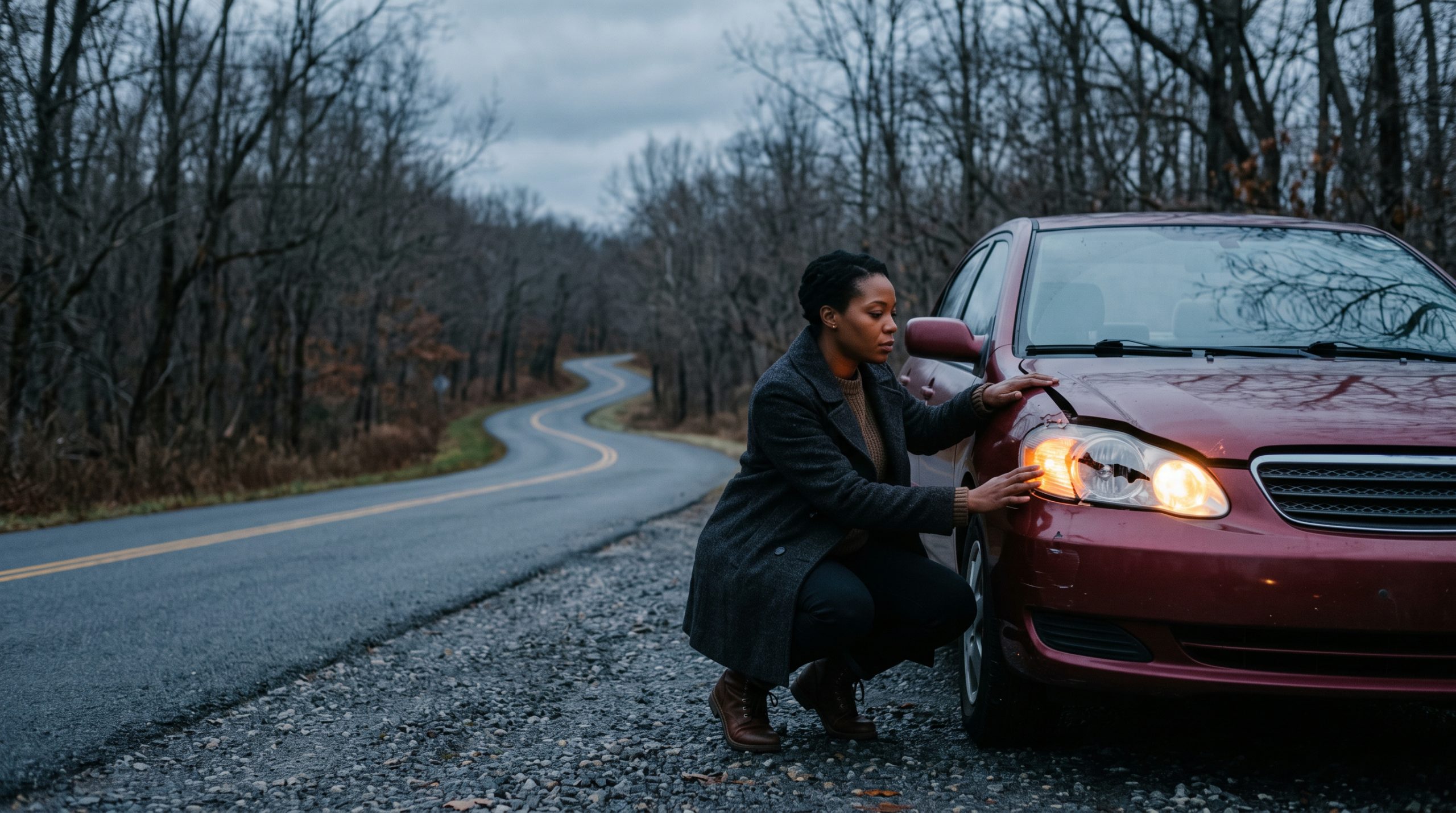
Michigan’s own insurance regulator and State Farm’s driver guidance line up on the same sequence: pull off the road safely, turn on your hazard lights, and call police if the animal is blocking traffic or creating a hazard. Don’t approach an injured or frightened animal, since one that looks dead may only be stunned. When it’s safe, document the damage with photos, and check for leaking fluids, loose parts, or a hood that won’t latch before deciding whether the car is drivable.
One state goes further than documentation. Maine’s own legislature states that under 12 M.R.S. §12403, “the operator or owner having knowledge of a motor vehicle that has been involved in an accidental collision with a deer, moose, bear or wild turkey shall, by the quickest means, report the accident to a law enforcement officer.”
A Maine officer who investigates and confirms damage can then issue a certificate letting the driver keep the carcass. This is a Maine-specific legal duty, not a nationwide requirement, so check your own state before assuming it applies.
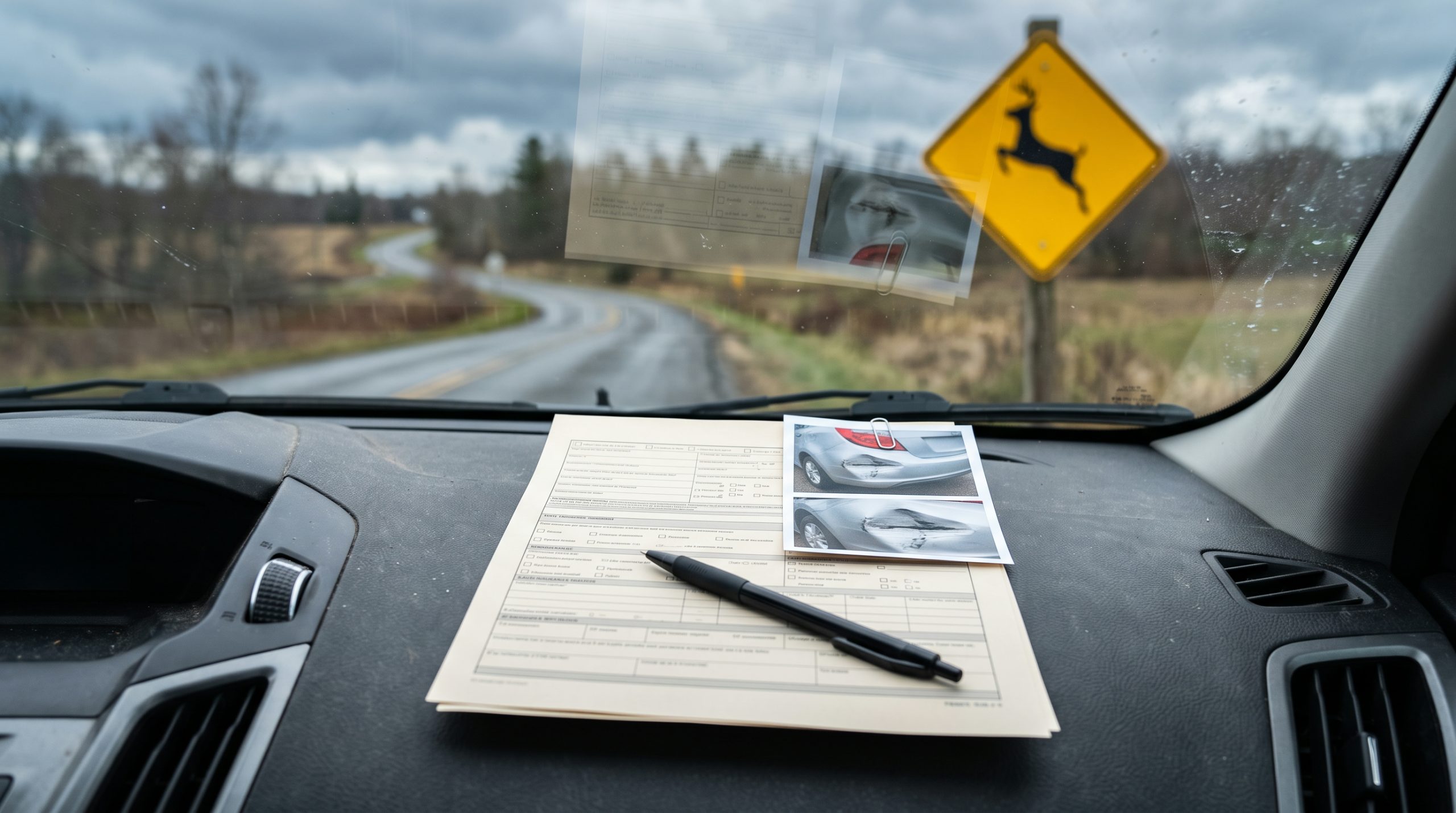
Most states don’t require a police report for a deer strike with no injuries, but most insurers still ask for photos and a description of how the contact happened when you actually file. That documentation request isn’t optional paperwork; it traces back to the same “duties after loss” condition every auto policy attaches to every claim, comprehensive or collision, and failing to cooperate with it can jeopardize payment regardless of how clearly the animal strike itself was comprehensive.
The deductible math: is it worth filing?
Safeco’s own consumer guidance puts $500 as the most common car insurance deductible generally, comprehensive included.
Say the repair estimate for a dented hood, a cracked headlight, and a bent grille, a plausible mix of damage from a deer strike, comes back at $1,500; that’s an illustrative figure to plug your own estimate into, not a sourced average.
- Repair estimate: $1,500
- Comprehensive deductible: $500
- Insurer pays: $1,500 minus $500, which is $1,000
- Your out-of-pocket cost to file: $500
Weighed against paying the full $1,500 yourself and skipping the claim, filing costs $500 and gets $1,000 covered, with no at-fault surcharge attached in most states. The same math scales in both directions. A grille-only estimate of $900 against that same $500 deductible nets only $400 from the insurer, barely worth the hassle of a claim.
A heavier estimate of $3,000, more likely if the radiator or a headlight assembly was hit, nets $2,500 for the identical $500 out of pocket. Your deductible itself matters more than the dent, because the deductible stays fixed no matter how large the repair bill gets.
The math changes fast if your deductible runs higher or the damage is minor enough to sit close to the deductible itself; at that point, filing may cost more in paperwork than it recovers.
Frequently asked questions
Does hitting a deer count as an at-fault accident? Usually not, since it’s filed as a comprehensive claim rather than a collision claim, but whether your rate actually moves depends on your specific state and insurer. Check your own policy or ask your agent directly rather than assuming either way.
What coverage pays for hitting a deer? Comprehensive coverage pays for contact with an animal. If you swerve to avoid the deer and hit another vehicle, a tree, or any other object instead, that damage falls under collision coverage.
Do I have to report hitting a deer to the police? It depends on the state. Maine has an explicit statutory duty to report a collision with a deer, moose, bear, or wild turkey to law enforcement by the quickest means. Most states don’t impose that legal duty, but documenting the damage with photos is still worth doing everywhere.
Will my insurance rate go up after a deer-strike claim? Often not, since a deer strike is typically treated as a not-at-fault event, but this varies by state and insurer. Some carriers and states still factor a comprehensive claims history into future pricing even without a direct surcharge.
Is it worth filing a claim for $1,500 in deer-strike damage? With a $500 deductible, the insurer covers $1,000 of a $1,500 repair, leaving you $500 out of pocket to file versus $1,500 out of pocket to skip it. Since most states don’t apply an at-fault surcharge to a comprehensive claim, filing is usually the better math once the damage clears the deductible by a meaningful margin.
Compare auto insurance coverage before deer season catches you off guard
See what comprehensive actually covers and what your deductible would cost you.
Compare Auto Insurance Options