8 min read · Last updated October 14, 2026
- A restaurant indemnifies its delivery platform for harm traced to its food or a health-code violation, “except to the extent” the platform or its Dashers caused the loss, per DoorDash’s own merchant terms.
- DoorDash’s own description of its contract carves indemnification and “any damages resulting from bodily injury, damage to property, or violation of applicable law” out of its mutual liability cap, but that carve-out protects a restaurant’s own claim against the platform, not the restaurant’s obligation running the other way.
- Whether a restaurant’s commercial general liability (CGL) policy backs its indemnification promise to the platform turns on the “insured contract” definition written into Section V of the Insurance Services Office (ISO) standard CGL form, and on whether a Contractual Liability Limitation Endorsement (ISO form CG 21 39) has stripped the clause that would otherwise pick it up.
- Ivans’ Q2 2026 Index puts general liability renewal rates up 5.44% industry-wide, so a renewal review is also the moment to check for that endorsement.
A restaurant’s indemnification promise to a delivery platform for harm caused by its own food is a real contractual obligation under the platform’s own terms, and the restaurant’s commercial general liability policy only backs that promise if it still contains the “insured contract” provision that a Contractual Liability Limitation Endorsement (ISO form CG 21 39) commonly strips out.
In this article
- Restaurant delivery platform liability: who answers for what
- Why an indemnification promise still needs your own insurance behind it
- Does your CGL policy actually answer this claim?
- The endorsement that can erase that answer
- Frequently asked questions
A restaurant’s delivery platform contract usually assigns blame by who caused the harm. One category gets less attention than it should: a restaurant’s promise to cover the platform for harm its own food caused is a binding obligation the moment the contract is signed, and the restaurant’s own insurance answers it only if one specific policy clause survived underwriting.
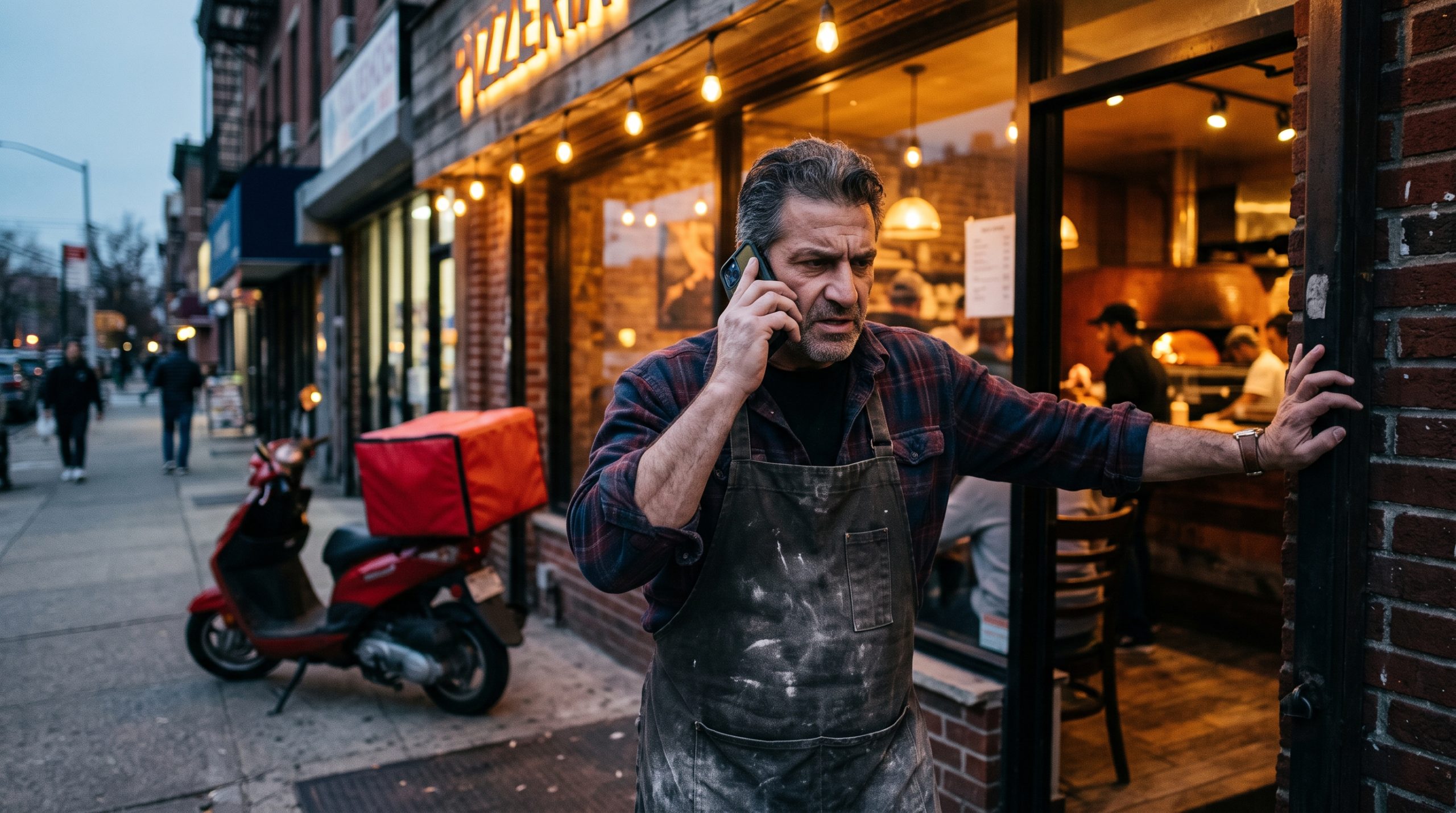
Teodoro Marchetti found this out at his pizzeria in Providence, Rhode Island, this spring. A DoorDash customer bit into a slice with a shard of glass baked into the crust and needed emergency dental surgery. The claim, once defense costs were added, ran past $212,000.
DoorDash’s own merchant terms made Teodoro’s restaurant responsible for harm “caused by the restaurant’s products.” His restaurant’s commercial general liability (CGL) policy answered the claim in full.
He later learned that outcome hinged on one endorsement his broker had never added. A different renewal, with that endorsement attached, would have left him paying every dollar of it himself.
Restaurant delivery platform liability: who answers for what
DoorDash’s own description of its merchant agreement splits responsibility by cause, not by who happens to get sued first. “DoorDash indemnifies our restaurant partners against any third party claims related to damage or harm caused by Dashers,” the company states on its merchant blog, using its own term for the independent drivers who deliver each order. The reverse promise runs the other way: “the restaurant partner indemnifies DoorDash against third party claims related to harm caused by the restaurant’s products or by the restaurant’s violation of any applicable health and safety code,” except to the extent the loss was caused by DoorDash or its Dashers.
That split sounds fair on paper. A customer hurt by a Dasher’s driving is DoorDash’s problem. A customer hurt by the food itself is the restaurant’s problem.
Most owners stop reading there and assume the obligation is just ordinary liability, something their general insurance already handles the way it handles any other claim.
It is worth reading more carefully than that. DoorDash’s own merchant blog states that the company has “carve-out certain categories of damages from the liability cap, including indemnification,” reaching “any damages resulting from bodily injury, damage to property, or violation of applicable law,” specifically “so that restaurants can make claims without any limit for these categories of losses.”
That protection runs toward the restaurant, for a claim the restaurant brings against the platform. It says nothing about shielding the restaurant from its own indemnification promise running the other way, toward DoorDash, for harm the restaurant’s own food caused. That promise still obligates the restaurant to pay, and it still needs the restaurant’s own insurance to answer it.
The obligation sits in the contract by design, not by an oversight either side can point to later. A foodborne illness outbreak traced to the kitchen itself raises this same indemnification question, separate from the products-completed-operations limit that claim would also draw on.
Why an indemnification promise still needs your own insurance behind it
An indemnification clause is a contract promise, not an insurance policy. If the restaurant has no liability coverage standing behind that promise, the restaurant pays it out of pocket, dollar for dollar, with nothing standing between the claim and its own bank account.
Teodoro’s $212,000 broke down into three pieces:
- Emergency dental reconstruction
- A short course of follow-up care
- The legal defense costs DoorDash’s counsel billed back once the claim was tendered
His CGL policy paid every dollar because it still treated the indemnification promise as a covered insured contract.
A single severe injury, a permanent one, or a case that goes to trial could run well past that figure. Without that same policy provision intact, every dollar of it lands on the restaurant directly.
The following table shows how three common claim scenarios land under a typical delivery platform merchant agreement, based on DoorDash’s own public description of its terms.
| Where the harm traces to | Who indemnifies under the contract | Whose insurance has to answer it |
|---|---|---|
| A Dasher’s driving or conduct | DoorDash indemnifies the restaurant | DoorDash’s own coverage |
| The restaurant’s food (foreign object, allergen, spoilage) | Restaurant indemnifies DoorDash | The restaurant’s CGL, if it still treats this as an insured contract |
| A health or safety code violation at the restaurant | Restaurant indemnifies DoorDash | The restaurant’s CGL, if it still treats this as an insured contract |
| Best for | Any restaurant signing a platform merchant agreement, regardless of delivery volume | |
Does your CGL policy actually answer this claim?
A restaurant’s commercial general liability (CGL) policy, the same policy that stops short of covering faulty workmanship on a construction job, excludes liability the restaurant assumed by contract, as a baseline rule. But that exclusion has a major carve-back: it does not apply to an obligation that qualifies as an “insured contract,” a defined term in Section V of ISO’s standard CGL form, CG 00 01.
Construction Executive’s review of the form describes several named categories inside that definition:
- A lease of premises
- A sidetrack agreement
- An easement or license agreement
- An elevator maintenance agreement
- A narrower municipal-indemnification category that specifically excludes an obligation tied to work the restaurant performs for the municipality itself
None of those fit a food delivery contract on their own.
The category that does fit sits in a broader catch-all clause, which the same review describes as reaching an agreement under which the restaurant assumes “the tort liability of another party” for bodily injury or property damage to a third person. That is exactly the shape of DoorDash’s indemnification promise. On an unmodified CGL form, this catch-all is what makes the obligation an insured contract, and makes the CGL respond.
The endorsement that can erase that answer
Many CGL policies, especially ones written for higher-risk or claims-heavy accounts, carry an endorsement that deletes that exact catch-all provision. Insurance Journal names it directly: “the CG 21 39 – Contractual Liability Limitation.”
The same article adds that, in most cases, the form “should be avoided at all costs as it almost completely guts the contractual liability coverage added by exception in the CGL policy.” Once attached, the policy no longer treats a general business indemnification promise as an insured contract, and the CGL has no duty to pay or defend it.
Teodoro’s broker confirmed his policy did not carry that endorsement, which is the only reason his $212,000 claim was covered rather than personal. Not every restaurant’s policy is written the same way. A restaurant that has had a prior liability claim, operates in a higher-risk cuisine category, or simply renewed through a different carrier can find CG 21 39 attached without anyone flagging what it removed.
Ivans’ Q2 2026 Index put general liability renewal rates up 5.44% industry-wide, following a 6.85% increase in the first quarter. A renewal conversation already covers the premium. It costs nothing extra to also ask the coverage question that decides whether a delivery platform’s indemnification demand comes out of the policy or out of the restaurant’s own bank account.
Frequently asked questions
Does a restaurant have to use a delivery platform’s standard merchant agreement, or can it negotiate the indemnification terms?
Independent restaurants almost never negotiate the standard terms individually; large chains sometimes do through their legal teams. For a single-location owner, the realistic path is reviewing what the standard terms already say and making sure the CGL policy matches that exposure, not trying to rewrite the platform’s contract.
Is the indemnification carve-out specific to DoorDash, or do other delivery platforms structure it the same way?
Each platform writes its own merchant agreement, and the exact wording differs. The pattern of splitting liability by cause and carving bodily injury or property damage claims out of a cap is common across the delivery-platform industry, so a restaurant working with more than one platform should check each contract rather than assume they match.
What should a restaurant do if its CGL renewal already shows a Contractual Liability Limitation Endorsement attached?
Ask the broker for a quote without it. Some carriers will remove it for an additional premium; others will not remove it at all for a given risk class, in which case the restaurant should know that in advance rather than discover it mid-claim.
Does this exposure only apply to foreign-object or allergen claims, or does a general foodborne illness claim count too?
A foodborne illness claim traced to the restaurant’s food or a health-code violation falls under the same indemnification language. The obligation applies to the category of harm, not the specific mechanism that caused it.
If a restaurant has never had a delivery-related claim, is this still worth checking now?
Yes. The endorsement question is a five-minute conversation at renewal, and the claim itself arrives with no warning. Checking before a claim exists is the only point at which the answer still costs nothing.
Compare commercial insurance quotes before your next renewal
See whether your CGL policy still covers contractual indemnification, and what it costs to fix it if it doesn’t.
Compare Business Insurance Quotes