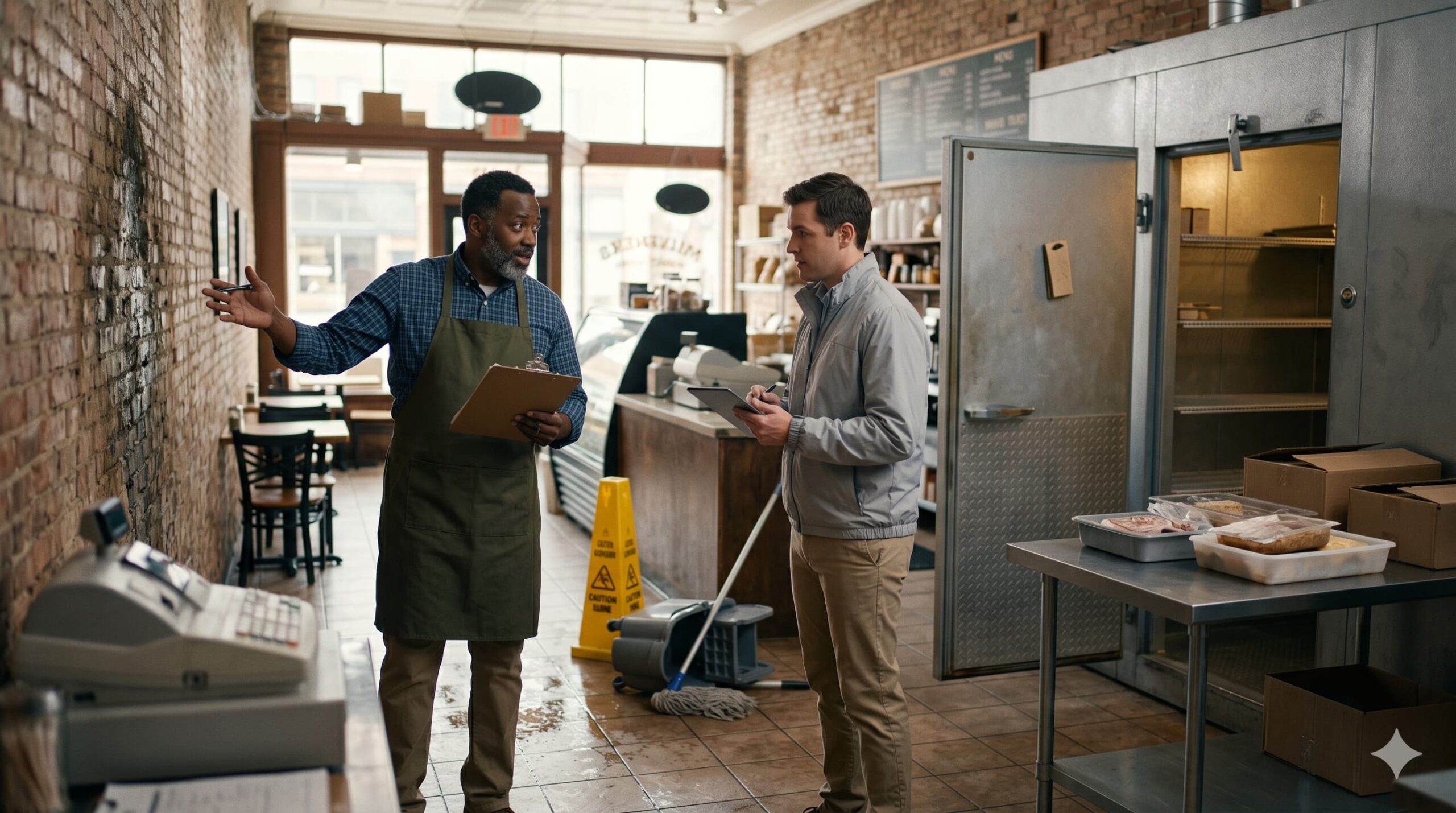
A Cleveland deli owner came back from a weekend trip to find that a $6,200 walk-in compressor had failed, $11,400 of inventory had thawed, and the back wall was soaked from the overflow. Three weeks later, his commercial property insurer offered him $9,800 against a total loss he eventually proved was $42,600. The difference was not luck. It was a three-day paper trail he almost did not build, and a series of small decisions he almost made wrong.
Hour Zero to Hour 24: Stop the Loss and Lock the Evidence
The first thing most business owners do after property damage is start cleaning up. That is the first mistake. Before you move a single box, mop a single puddle, or throw out a single case of spoiled product, you document. Photograph the damage from at least four angles per room, video-walk through the entire affected area, and narrate what you are seeing out loud while the phone records it. Get wide shots, mid shots, and close-ups of any identifying marks on equipment, serial numbers on damaged appliances, and model tags on anything the insurer will need to replace.
Then you stop the loss. Your commercial property policy has a “duty to mitigate” clause that requires you to prevent further damage. Shut off the water, cover broken windows with a tarp, move dry inventory away from wet zones, and call a commercial restoration company if the damage is biological or structural. Keep every receipt for mitigation work. Those expenses are reimbursable under almost every commercial property policy, but only if you can document the cost and the reason.
Do not authorize any permanent repairs in the first 24 hours. Mitigation is a temporary fix to prevent further loss. Permanent repairs happen after the adjuster has scoped the damage, and any work you do before then is work the insurer can refuse to reimburse on the grounds that they could not verify the original condition.
Hour 24 to Hour 48: File the Claim and Pull the Records
Once the scene is secure and documented, file the claim. Call your broker first, not the carrier, if you have one. A good broker knows how the specific adjuster assigned to your region works, which documentation the carrier responds to, and whether your policy has any quirks that need to be flagged early. When you call the carrier, give them the basics: the date, the cause, the type of damage, and the fact that you are still compiling the full loss. Do not give them a dollar estimate, do not speculate about cause, and do not sign anything the adjuster emails you in the first 48 hours without reading the entire document.
While the claim opens, start pulling records. You need your current inventory report (from your POS, warehouse management system, or last physical count), the last 24 months of monthly profit-and-loss statements, your last two federal tax returns, receipts or asset registers for any equipment destroyed, and contracts for any service agreements that covered the damaged property. Business interruption claims live or die on those P&L statements because the insurer calculates lost income by comparing revenue during the closure to revenue in the same period during prior years. If your financials are disorganized, the carrier gets to pick the comparison window, and they will pick the slowest one.
Open a claim file the same day. A physical folder or a single cloud folder titled with the claim number, with subfolders for photos, videos, receipts, correspondence, and estimates. Every call, every email, and every visit gets logged with a date, a name, and a summary. The claim file is what a public adjuster or attorney will ask for if the claim gets difficult, and it is what makes the difference between “here is my side” and “here is the record.”
Hour 48 to Hour 72: Build the Damage Package
By hour 48, the adjuster has either scheduled a site visit or asked you to submit a sworn statement in proof of loss. Before either happens, build your damage package. A damage package has three components: a property repair estimate, an inventory loss schedule, and a business interruption calculation.
Get two or three bids from independent contractors for the physical repair work. Not one, two, or three, from contractors who do commercial work in your type of space. An adjuster can hand a single bid that will price the job against their own industry database and often come in 20 to 40 percent below it. Handed three bids that cluster around the same number, the database argument is gone.
Build the inventory loss schedule from your POS or warehouse system, not from memory. Export a report showing on-hand inventory as of the last count before the damage, reconcile it against sales through the date of the loss, and produce a line-item list of what was destroyed with current replacement cost, not what you paid for it. Replacement cost policies pay to replace at today’s prices. Actual cash value policies pay depreciated value. Read the declarations page of your policy before you build the schedule, so you know which one you have.
The business interruption number comes from your P&L. Calculate actual revenue lost during the closure against the same month in prior years, subtract variable costs that did not occur (like products you did not buy because you were closed), and arrive at a net income loss figure. Add extra expenses you incurred to stay partially operational, including temporary space, emergency equipment rental, and overtime labor. That is the BI claim.
Working the Adjuster Without Handing Over the Settlement
The adjuster who walks your space is neither your enemy nor your friend. They are professionals tasked with closing the claim for the lowest defensible number the policy allows. Treat the relationship accordingly. Walk them through the damage with your documentation in hand, answer direct questions directly, and do not volunteer information about prior maintenance issues, prior claims, or prior conversations with your broker about coverage. None of that helps you. If the adjuster asks a question that requires documentation to answer, tell them you will send the documentation and do not guess on the spot.
When the first offer arrives, read it line by line. Compare every line item to your damage package. If the adjuster’s scope lists “wall repair, $1,500” and your contractor’s bids say $4,200, respond in writing with the three bids attached. If the inventory line says “$4,500” and your POS schedule says $11,400, send the POS schedule. Every number the adjuster cannot defend against paper gets moved up. Every number they can defend stays.
Most commercial property policies also have a 60 to 90-day proof-of-loss deadline that runs from the date of damage, not the date you first spoke to the adjuster. Missing that deadline can void the claim regardless of merit, and adjusters rarely volunteer the date. Write it on the front of your claim file the day you open it.
If your loss is over $25,000 and the carrier’s first offer is less than 60 percent of your documented package, consider hiring a public adjuster. They typically charge 10 to 15 percent of the final settlement and, on losses of that size, recover final settlements that average 2 to 3 times higher than carrier-direct claims, according to industry data. On a $50,000 loss, paying 12 percent of a $120,000 settlement still leaves you far ahead of accepting a $45,000 offer.
Pull your business interruption policy language now, before anything goes wrong, and make sure you understand what triggers BI coverage and what is excluded. The same owner who reads the language at renewal is the same owner who has the P&L exports ready on hour 24.
Questions to Ask Your Broker and Your Adjuster
- What is my exact proof-of-loss deadline, and is it 60, 90, or 120 days from the date of the loss?
- Does my policy pay replacement cost or actual cash value on inventory, and does the answer differ for equipment, fixtures, and stock?
- What documentation does the carrier require for a business interruption claim, and do they accept my P&L format or will they want a CPA-prepared statement?
- What is my co-insurance clause, and am I carrying enough property limit to avoid a co-insurance penalty on a partial loss?
- If the first offer comes in low, what is the formal dispute process, and is there appraisal or mediation built into my policy?
The Offer Is Not the Answer
The Cleveland deli owner did not get $42,600 because he fought the insurer. He got it because he built a damage package that the insurer could not dispute. Photographs, POS reports, contractor bids, a nine-day business interruption calculation with tax returns attached, and a claim file dated and timestamped from hour one. When the first offer came in at $9,800, his written response included all the documents in the package and a one-paragraph cover letter explaining the full loss. The revised offer came in at $38,900. A final negotiation on the BI calculation closed the rest. An annual coverage review with the broker the previous fall is what put him on replacement-cost coverage in the first place, and that single endorsement was worth roughly $14,000 of the final number.
If the worst week you have had at your business happened yesterday, the next 72 hours are the ones that decide what the settlement looks like.
Is your commercial property policy built to survive a real claim?
The difference between a $9,800 offer and a $42,600 settlement is coverage structure, not luck. Compare business insurance quotes in minutes.
Get Business Insurance Quotes →