9 min read · Last updated November 27, 2026
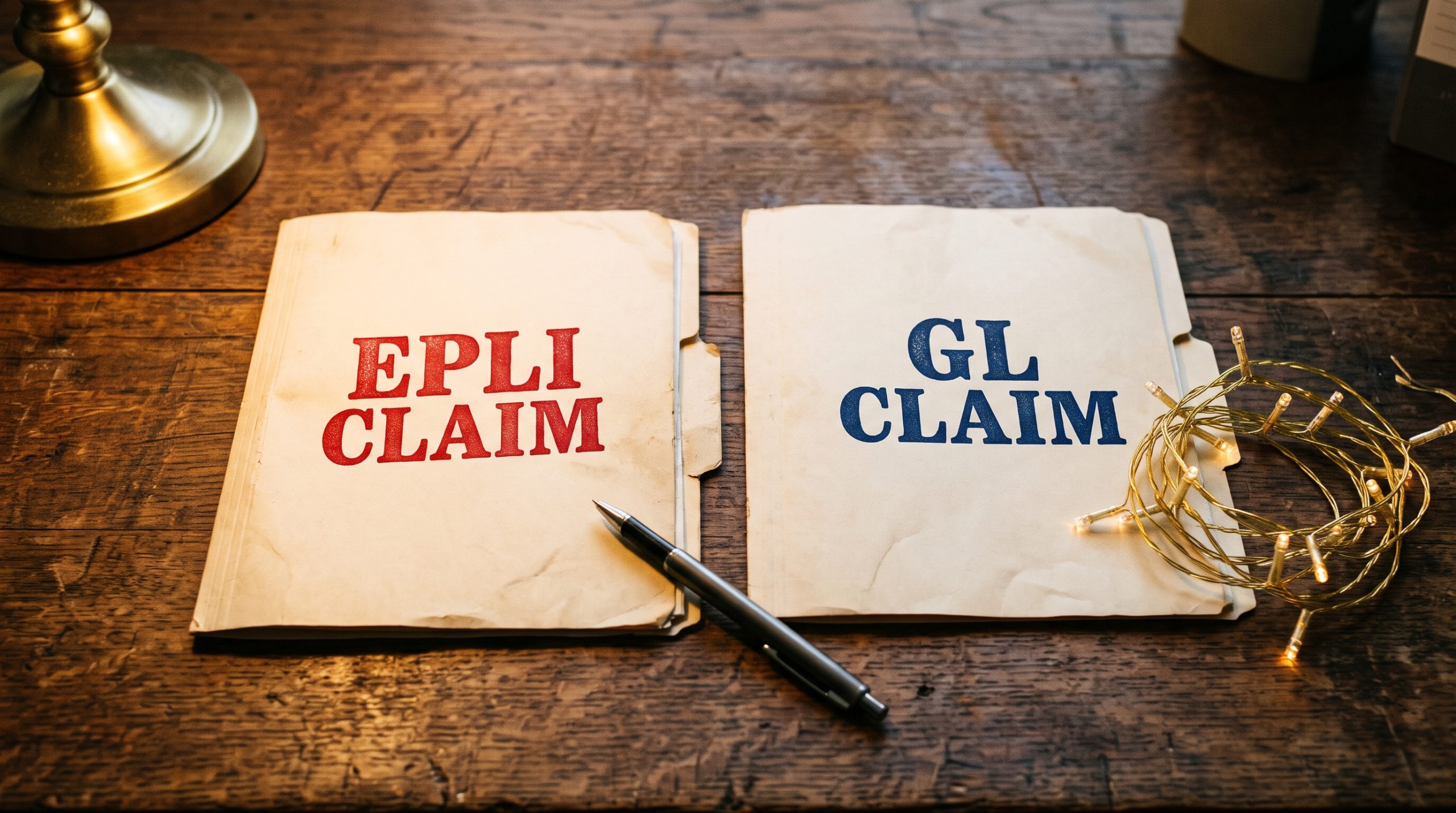
A single company holiday party can trigger holiday party insurance claims against two completely different policies at once. A harassment complaint from an employee can only go to the Employment Practices Liability Insurance (EPLI) policy, because the standard commercial general liability (CGL) policy excludes employment-related claims by name.
A drunk-driving crash caused by an employee who was over-served at the same party can go to a different policy instead: the CGL policy’s host liquor liability provision. Each policy runs on its own notice clock, so missing one can void a claim the other policy pays without issue.
- A standard CGL policy’s Employment-Related Practices Exclusion, an Insurance Services Office (ISO) form numbered CG 21 47, blocks every employment claim from reaching general liability coverage at all. It only goes to EPLI.
- EPLI is typically written on a claims-made-and-reported basis, meaning a policy can deny a claim solely for being reported late, even when the underlying complaint is clearly covered.
- In AV Builder Corp. v. Houston Casualty Co. (9th Cir. 2023), an insurer denied a sexual harassment claim over timing alone. The policyholder had reported it roughly two months after first learning of it, just past the policy’s own 60-day notice window.
- A drunk-driving crash caused by an employee who overindulged at a one-time company party is usually a CGL host liquor liability claim, not an EPLI claim. Hosting one party a year doesn’t put a business “in the business of” alcohol.
In this article
- Why a holiday party’s insurance claim has nowhere else to go
- Why the drunk-driving crash lands on a different policy entirely
- The deadline that decided a real case
- What a notice condition actually requires, and why the two policies differ
- Frequently asked questions
Why a holiday party’s insurance claim has nowhere else to go
Most CGL policies carry the ISO Employment-Related Practices Exclusion, form CG 21 47, as a standard attachment. It removes coverage for bodily injury and “personal and advertising injury” tied to refusal to employ or termination. It also reaches employment-related practices such as coercion, demotion, evaluation, discipline, defamation, harassment, humiliation, or discrimination directed at a person.
The exclusion applies whether the insured is acting as the employer or in any other capacity, and it reaches claims from job applicants and former employees, not only current payroll.
That’s why a harassment complaint from the holiday party has nowhere to go but the EPLI policy. A plaintiff’s attorney might try to frame it instead as defamation or emotional distress, theories general liability would otherwise pick up, but the exclusion blocks those too.
EPLI exists specifically because the industry carved that gap out of the CGL form on purpose. It’s usually sold on a claims-made basis, with its own retention, its own limits, and notice rules that look nothing like the CGL policy sitting right next to it.
Why the drunk-driving crash lands on a different policy entirely
A drunk-driving crash is a different animal. If an employee drinks at the company party and causes a wreck on the way home, the injured third party has a claim against the business. That claim usually belongs to the CGL policy’s host liquor liability exposure, not EPLI, since it has nothing to do with an employment practice at all.
The CGL form’s liquor liability exclusion applies only to a business “in the business of” manufacturing, distributing, selling, serving, or furnishing alcoholic beverages. None of its three clauses apply at all unless that test is met. The International Risk Management Institute (IRMI) is direct about what that leaves standing. A company picnic or an open house at which alcohol is served is exactly the kind of event host liquor liability coverage is built for.
Should an employee at that kind of event overindulge and injure others because of their intoxication, IRMI’s own commentary is direct. It states plainly that “the unendorsed CGL will protect the insured from claims made by persons injured by the overserved employee or customer.” A once-a-year office party reads the same way.
DIN has covered the host liquor mechanic itself in more depth, including the “in the business of” test courts actually apply, in host liquor liability under the CGL. That means one party can put one claim on the EPLI policy and an unrelated second claim on the CGL policy. Two different carriers and two different adjusters decide whether either one pays.
The deadline that decided a real case
A claims-made-and-reported EPLI policy doesn’t just want to know about a claim eventually. It wants to know within its own stated window, and courts have repeatedly enforced that window as written, regardless of whether the underlying harassment complaint was legitimate.
In AV Builder Corp. v. Houston Casualty Co., 2023 WL 6566510 (9th Cir. Oct. 10, 2023), a former employee sued two California companies, AV Builder Corp. and RestorCorp., along with their president, for sexual harassment. Houston Casualty, the companies’ EPLI insurer, denied coverage entirely.
The denial wasn’t about the merits of the harassment claim. It came down to timing: the companies had actual notice of the claim “by at least” August 14, 2018, but didn’t report it to Houston Casualty until October 15, 2018, more than 60 days later.
The district court granted Houston Casualty summary judgment, and a three-judge Ninth Circuit panel affirmed it. The underlying harassment claim may well have been covered. It never got the chance, because the notice clock ran out first.
What a notice condition actually requires, and why the two policies differ
According to Wiley Law’s summary of the case, the policy required the insured to notify the carrier “within sixty (60) days or as soon as practicable” after a claim is made. Separately, notice was due no later than 60 days after actual receipt of the claim, or 30 days after the policy’s expiration, whichever came first.
That specific day count is written into that particular policy, not a universal EPLI rule. The structure behind it is standard: a claims-made-and-reported EPLI form needs both the claim and the notice of it inside the same policy period, or a defined extended reporting period. Many courts have enforced that structure without requiring the insurer to prove it was actually harmed by the delay.
A CGL policy’s host liquor liability coverage works differently. CGL is typically written on an occurrence basis, meaning the policy in force when the injury happened is the one that answers, regardless of when the claim is eventually reported.
There’s still a notice condition requiring the insured to report “as soon as practicable.” But a late report to an occurrence policy is a much harder thing for an insurer to use as an outright denial. Many states require the insurer to show it was actually prejudiced by the delay before coverage can be refused on that basis alone.
| Question | CGL / host liquor liability | EPLI |
|---|---|---|
| Trigger type | Occurrence (the policy in force when the injury happened responds) | Claims-made-and-reported (claim and notice both have to land in the same policy period) |
| Who’s the claimant | An injured third party, not an employee | An employee, former employee, or job applicant |
| Typical notice rule | “As soon as practicable” after the injury occurs | Often a fixed day count tied to the insured’s own receipt of the claim, plus a separate cutoff after the policy expires |
| What a late report risks | Many states require the insurer to show real prejudice before denying on notice alone | Courts have repeatedly allowed denial for late notice with no prejudice requirement at all |
| What it never covers | Employment-related claims, excluded outright by CG 21 47 | Ordinary third-party bodily injury or property damage unrelated to an employment practice |
The practical lesson for a business running one employee event a year isn’t that either policy is unreliable. It’s that an employer who hears about a possible harassment complaint and a possible host liquor claim from the same party needs to report both, to both carriers, right away. Don’t wait to see whether either one turns into a real lawsuit first.
General liability rates have been easing through 2026, even as the lines most exposed to exactly this kind of claim stay under pressure. Ivans’ own index put commercial general liability renewals at +4.12% in the third quarter of 2026, down from +5.44% the quarter before.
The Council of Insurance Agents & Brokers’ (CIAB) broker survey for the same quarter lists employment practices liability among the lines that decreased, alongside cyber and business interruption. The exact percentage wasn’t published this cycle.
Frequently asked questions
Does workers’ compensation cover an injury at a company holiday party? Workers’ comp can apply if an employee is hurt at a mandatory company event, but it has nothing to do with a harassment claim from a coworker or a third-party injury from a drunk-driving crash after the party. Those are separate claims on separate policies, governed by separate rules.
Can the same insurer write both the CGL and EPLI policy for one business? Yes, and many carriers bundle both inside a business owners policy or a package policy. Even when one insurer writes both, the two coverage parts still have separate trigger rules, separate notice conditions, and separate claim files, so reporting a claim under one coverage part doesn’t automatically put the insurer on notice under the other.
What happens if a business doesn’t report the host liquor claim right away? An occurrence-based CGL policy still requires notice “as soon as practicable,” and an insurer can raise a late-notice defense. In many states, though, the insurer has to show the delay actually hurt its ability to investigate or defend the claim before a court will let that defense stand on its own.
Does serving alcohol at a holiday party put a business “in the business of” alcohol? Generally not. Courts interpreting the CGL’s liquor exclusion have read “in the business of” to mean a commercial enterprise with a profit motive in selling alcohol, which a once-a-year company party doesn’t meet. That’s exactly the gap host liquor liability coverage exists to fill.
Is an EPLI policy required to prove it was harmed by a late claim report? Not always. Several courts, including the Ninth Circuit in the AV Builder Corp. case, have enforced a claims-made-and-reported policy’s notice deadline as written and denied coverage for late reporting without requiring the insurer to show actual prejudice from the delay.