8 min read · Last updated October 28, 2026
- A functional replacement cost endorsement, an Insurance Services Office (ISO) form numbered HO 05 30 or HO 05 31, settles a covered loss using current, commonly used materials and methods, not the original obsolete ones like lath-and-plaster.
- It is not a penalty clause. Insurers attach it to older homes because insuring true like-kind-and-quality reconstruction on a 1925 house is often unaffordable or simply unavailable to write.
- The 80 percent coinsurance-style requirement is measured against the cheaper functional replacement cost, not true replacement cost, which is exactly why it is easier to satisfy and does not close the restoration gap.
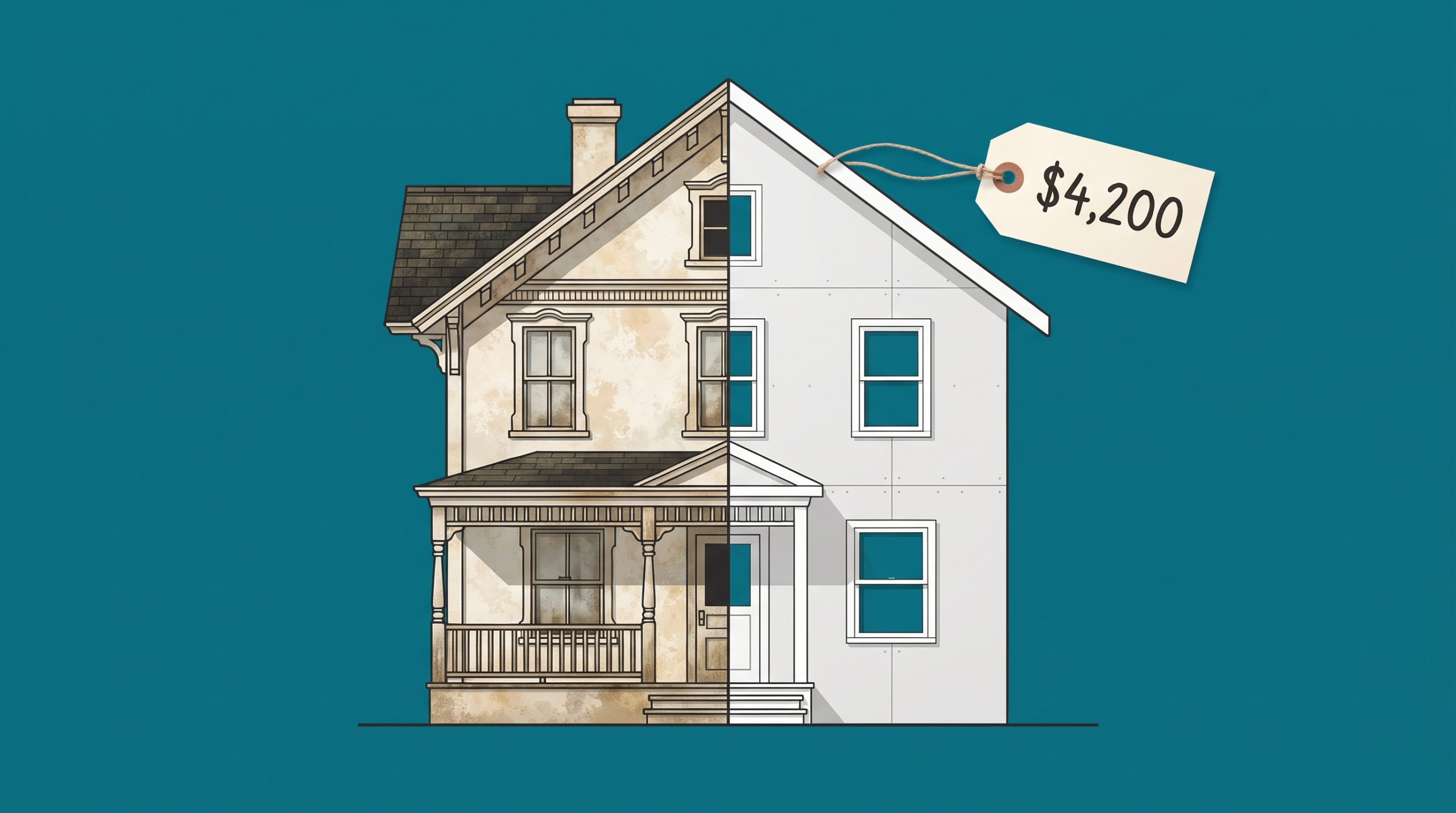
- On a 200 square foot repair, the real-dollar gap between a drywall rebuild and genuine wood lath and lime plaster restoration runs roughly $4,000 to $4,400.
A functional replacement cost endorsement settles a covered loss using current, commonly available construction materials and methods, such as drywall, not the original materials the home was actually built with. That is the valuation basis already sitting on many older-home policies, as Agnieszka Nowak found out when a burst pipe cracked the original plaster ceiling in her 1925 bungalow.
In this article
- What a Functional Replacement Cost Endorsement Actually Pays For
- Actual Cash Value vs. Functional Replacement Cost vs. Guaranteed Replacement Cost
- Agnieszka’s Burst Pipe: What Drywall Costs vs. What Real Plaster Costs
- Frequently asked questions
Agnieszka had owned the house for six years and never read past the declarations page. She did not remember choosing a functional replacement cost endorsement, and in her case she likely did not choose it in any meaningful sense.
When her agent shopped the home at purchase, at least one standard carrier declined to write full replacement cost on the house. It had original lath-and-plaster walls and knob-and-tube wiring in the attic. The carrier that did write the policy attached a functional replacement cost loss settlement endorsement instead, and that was the version of “full coverage” she actually had.
What a Functional Replacement Cost Endorsement Actually Pays For
DIN’s guide to extended and guaranteed replacement cost already covers the two most common ways insurers raise the ceiling above a dwelling limit. Functional replacement cost is not a ceiling question at all. It changes what the insurer agrees to rebuild with in the first place, regardless of how high the limit sits.
The International Risk Management Institute, known as IRMI, defines functional replacement cost plainly. It’s “the cost of acquiring another item of property that will perform the same function with equal efficiency, even if it is not identical to the property being replaced.”
As an endorsement, IRMI notes it changes the valuation basis that would otherwise apply, actual cash value or true replacement cost. The new basis is the cost of replacing damaged property with something that does the same job. It is used, IRMI says, when replacing damaged property with something substantially identical is either impossible or unnecessary.
For homeowners, that mechanic lives in two ISO forms, HO 05 30 and its companion HO 05 31, both titled Functional Replacement Cost Loss Settlement. Insurance trade press describes the endorsement’s own definition of the term. The Fire, Casualty and Surety insurance reference, known as FC&S, published via PropertyCasualty360, defines it as “the amount which it would cost to repair or replace the damaged building with less costly common construction materials and methods which are functionally equivalent to obsolete, antique or custom construction materials and methods used in the original construction of the building.”
HO 05 31 is the version carriers file where state law bars settling for less than actual cash value. HO 05 30 applies everywhere else. Neither form covers personal property.
Contents inside the home still settle separately, on actual cash value unless a different endorsement adds replacement cost coverage.
The same trade-press source lays out the terms most homeowners never see explained. The insured must carry at least 80 percent of the home’s functional replacement cost. To get the full payout rather than actual cash value, the insured must contract for repair or replacement of the damaged building for the same use within 180 days of the damage.
If coverage falls short of that 80 percent threshold, the payout shrinks proportionally. That proportional-shortfall mechanic is close cousin to the gap DIN has already covered in underinsured dwelling coverage.
One difference matters: here the 80 percent is measured against the cheaper functional replacement cost, not against true replacement cost. That is precisely why insurers can require it on a home that could never pass an 80 percent test against real plaster, real old-growth lumber, and real galvanized plumbing.
Actual Cash Value vs. Functional Replacement Cost vs. Guaranteed Replacement Cost
Each of these three valuation bases answers a different question about what a payout is measured against. The table below lines them up side by side for a damaged section of an older home.
| Valuation basis | What it pays for | Restores original materials? | Best for |
|---|---|---|---|
| Actual cash value (ACV) | Replacement cost of the damaged section, minus depreciation for age and wear | No, and typically pays the least of the three | Carriers settling detached structures or as a fallback basis, rarely chosen voluntarily |
| Functional replacement cost (HO 05 30 / HO 05 31) | Cost to rebuild with current, commonly used materials that serve the same function | No, settles on drywall, modern doors, and standard fixtures in place of obsolete originals | Older or historic homes a standard carrier will not write on full replacement cost |
| Guaranteed or extended replacement cost | True like-kind-and-quality rebuild cost, often with no cap or a 25 to 50 percent buffer | Yes, this is the basis built to fund genuine restoration | Historic homes insured through a specialty or high-net-worth carrier willing to write it |
Moving from functional replacement cost to a true like-kind-and-quality basis is not something a homeowner can simply request midterm on the same policy. The HO 05 30 and HO 05 31 endorsements do not include an option to decline functional settlement in exchange for more money. If the insured doesn’t elect to settle on the functional basis, FC&S’s own description of the forms has the insurer paying whichever is least: the policy’s limit of liability, actual cash value, or the functional replacement estimate.
Getting true restoration funded means moving to a carrier or program built for it before a loss happens.
The Andover Companies, a regional insurer that specializes in historic home coverage, offers an Extended Reconstruction Cost endorsement that adds 25 to 50 percent more coverage. The company describes it as funding restoration “with historically accurate craftsmanship, design, and layout, and materials of like kind and quality.” That is the buy-back option, and it has to be underwritten in advance, not invoked after a claim is already open.
Agnieszka’s Burst Pipe: What Drywall Costs vs. What Real Plaster Costs
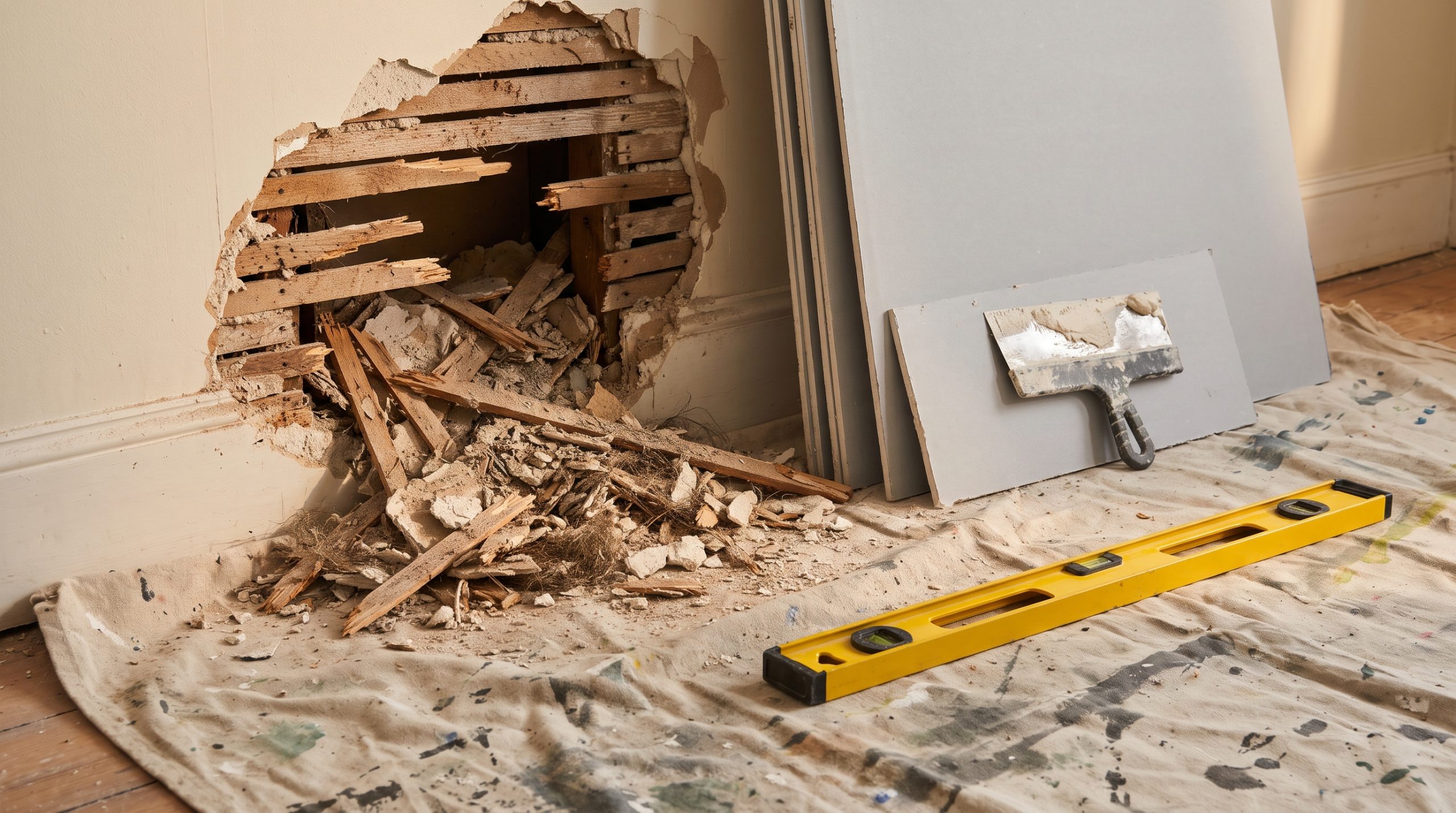
A supply line behind Agnieszka’s upstairs bathroom wall split open overnight and soaked the ceiling and a section of wall in the kitchen below before anyone noticed. The adjuster’s estimate covered 200 square feet of damaged plaster and lath between the ceiling and the wall section beneath it.
Under her policy’s functional replacement cost endorsement, the settlement used a standard estimating-software rate for replacing damaged plaster with drywall: $2.38 per square foot. That figure comes from a widely cited Xactimate line-item example discussed in legal analysis of functional replacement cost claims.
Two hundred square feet at $2.38 comes to $476.
That is the check Agnieszka’s insurer cut.
Even a modern plaster look-alike, not true restoration, costs more than that. The same estimating example prices a gypsum blueboard base finished with acoustic plaster at $8.47 per square foot, more than three and a half times the drywall rate. As the same source puts it, “it would be hard to find new horsehair plaster today.”
Genuine restoration costs more still.
The Craftsman Blog’s old house repair cost guide is built from contractor pricing for historic restoration work. It lists new three-coat lime plaster over newly installed wood lath at $1,800 to $1,950 for a standard 10-by-8 wall, 80 square feet. That works out to $22.50 to $24.38 per square foot.
Scaled to Agnieszka’s 200 square feet, real wood lath and lime plaster restoration runs $4,500 to $4,875. Her functional replacement cost payout was $476.
The gap she would have to cover herself to get her ceiling and wall back in genuine plaster, rather than drywall, is roughly $4,024 to $4,399, call it $4,200. She took the drywall.
Frequently asked questions
What is functional replacement cost insurance? Functional replacement cost is a homeowners valuation basis, applied through ISO endorsement HO 05 30 or HO 05 31, that pays to rebuild damage using current, commonly used materials and methods rather than the original obsolete materials, such as drywall instead of lath-and-plaster. It is most often attached to older homes a standard carrier will not insure to true replacement cost.
Can I remove a functional replacement cost endorsement from my homeowners policy? Sometimes, but usually only by switching carriers or programs, not by requesting a change on the same policy. Some carriers decline full replacement cost on homes with original plaster, old-growth lumber, or outdated wiring and plumbing entirely, and functional replacement cost is the only full-coverage option they will write.
Does functional replacement cost cover knob-and-tube wiring or galvanized plumbing? It covers rebuilding the damaged system with current materials and methods, meaning modern wiring or copper or PEX (cross-linked polyethylene) plumbing, not a like-for-like replacement of the obsolete original. Many carriers also require older wiring and plumbing be upgraded or inspected as a condition of coverage, separate from how a claim is later settled.
Is functional replacement cost the same as actual cash value? No. Actual cash value pays replacement cost minus depreciation, which typically produces the lowest payout of the three valuation bases. Functional replacement cost pays the undepreciated cost of a modern, functionally equivalent rebuild, which is usually more than actual cash value but less than true like-kind-and-quality replacement cost.
A $4,200 Gap Between Drywall and Real Plaster
If your home was built before 1950, find out before a claim whether your policy settles in drywall or in the materials it was actually built with.
Compare Homeowners Coverage