8 min read · Last updated August 7, 2026
- California’s FAIR Plan, the state’s insurer of last resort, carried $768 billion of total exposure as of June 2026, up 250% since September 2022, as standard carriers pulled back from wildfire-exposed areas.
- The FAIR Plan’s own Dwelling Fire policy insures only named perils: fire and lightning, internal explosion, and smoke, plus optional vandalism coverage. It carries no liability coverage and no standard theft or water damage coverage.
- The fix sold alongside it is a Difference in Conditions, or DIC, policy, written by a separate private carrier. The FAIR Plan states plainly on its own site that “the California FAIR Plan does not offer DIC policies.”
- Not every state’s insurer of last resort is a FAIR Plan. Florida’s Citizens and Texas’s TWIA are structurally different programs, and assuming they work like a FAIR Plan means assuming the wrong coverage.
In this article
- What replaced Marisol’s policy
- What a FAIR Plan actually promises to pay
- The policy sold to fill the gap
- Not every last-resort insurer is a FAIR Plan
- Frequently asked questions
Marisol Trejo’s homeowners insurer non-renewed her policy in March after fourteen years, citing an updated wildfire risk score for her Nevada County zip code. She landed on the California FAIR Plan’s Dwelling Fire policy at $4,140 a year for $620,000 of coverage on her house. Her agent’s next sentence was the one that mattered. The new policy pays nothing if a guest is hurt on her property.
What replaced Marisol’s policy
The California FAIR Plan is not a state agency and receives no tax dollars. It is a mandatory pool: every insurer licensed to write property insurance in California has to participate, under a structure the Legislature created in 1968 under California Insurance Code sections 10090 and following. The FAIR Plan’s own president told the state Assembly that it is “not for profit” and “not subject to Prop 103,” California’s rate-regulation ballot initiative, per the Assembly’s own hearing record.
It has also grown faster than almost anything else in the state’s insurance market. As of June 2026, the FAIR Plan’s total exposure reached $768 billion, up 11% since September 2025 and up 250% since September 2022. Total policies in force reached 696,562, up 157% over the same three years. That growth is standard carriers stepping back from wildfire-exposed neighborhoods, one non-renewal notice at a time, and homeowners landing where Marisol landed.
What a FAIR Plan actually promises to pay
Read the FAIR Plan’s own coverage description and the gap is stated plainly, not buried. “The California FAIR Plan Dwelling Fire Policy is a named peril policy, which provides coverage only for damage caused by the specific causes of loss listed in the policy,” the plan’s own site states: “Fire & Lightning, Internal Explosion, Smoke. Optional coverages are available at an additional cost, such as coverage for vandalism and malicious mischief.” That is the complete list. No liability. No theft. No water damage beyond what a fire itself might cause.
The dwelling limit has grown alongside demand, extended to $3 million as of 2022, up from $1.5 million, with the commercial per-location limit raised separately to $20 million. Marisol’s $620,000 house fits well inside the residential cap, and the FAIR Plan’s own September 2025 disclosure shows why her $4,140 premium lands where it does: statewide average homeowner premium ran just over $3,000 a year, ranging from $92 to $32,000 depending on the zip code. She is paying near the middle of that range for strictly less than what her prior policy covered, because the number on the declarations page describes a dwelling limit, not a promise about what else the policy will pay for.
Nothing about the size of that check tells a homeowner what it actually buys. A $620,000 dwelling limit and a $6,200,000 one are the same coverage in every category except the dollar figure attached to fire, lightning, explosion, and smoke. The categories that are missing do not become present at a higher limit.
The policy sold to fill the gap
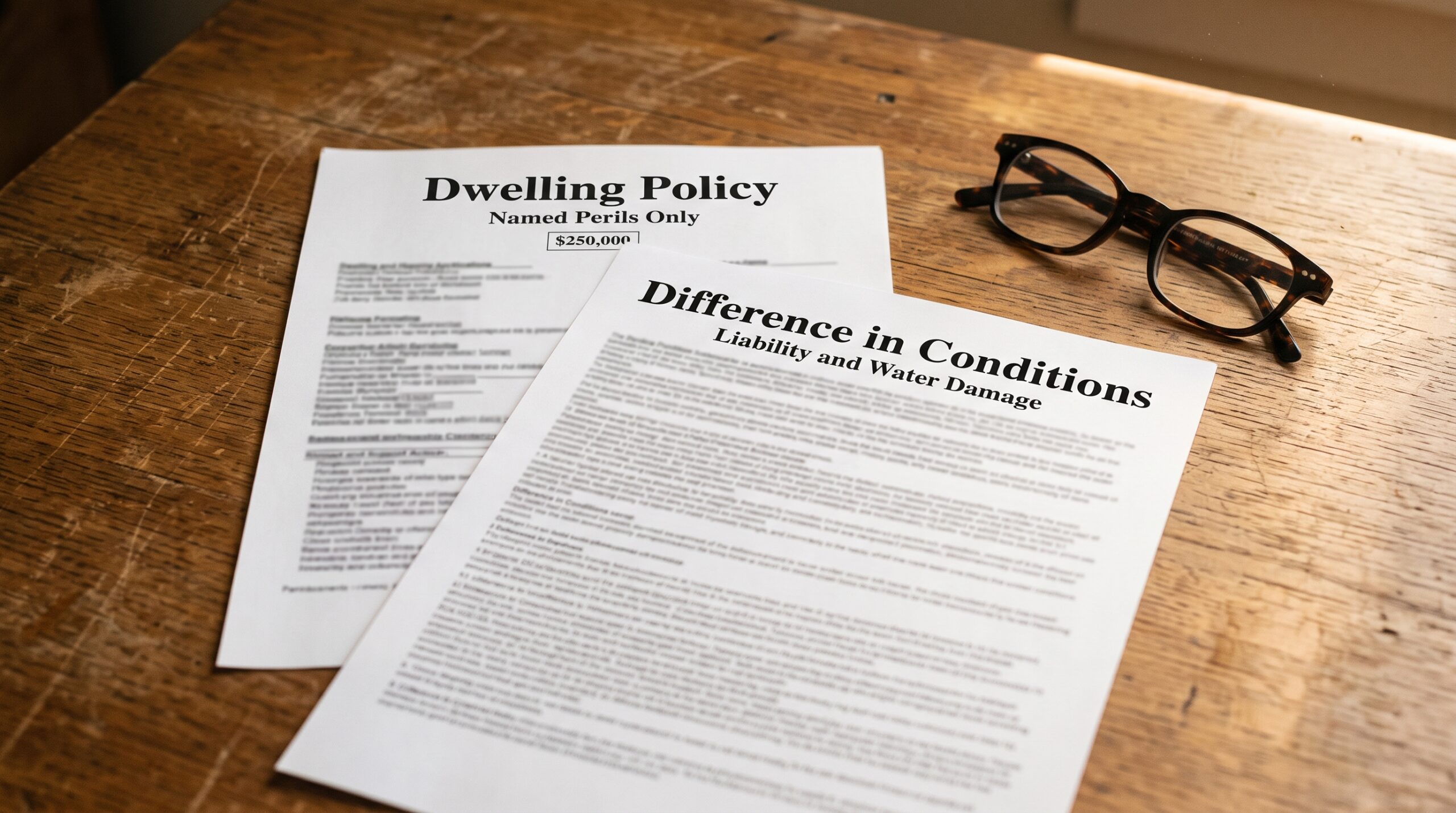
A Difference in Conditions policy, sold by a separate private carrier through a broker, is designed to sit alongside a FAIR Plan policy and add what it leaves out. The FAIR Plan is direct about the boundary: it states outright that “the California FAIR Plan does not offer DIC policies” and describes DIC coverage as “designed to combine with a California FAIR Plan policy to provide coverage similar to that in a comprehensive homeowner’s policy.”
| Coverage | FAIR Plan Dwelling Fire policy | DIC wrap policy |
|---|---|---|
| Fire, lightning, internal explosion, smoke | Included | Not needed, already covered |
| Vandalism and malicious mischief | Optional add-on | Not applicable |
| Water damage, non-fire | Not covered | Typically included |
| Theft | Not covered | Typically included |
| Liability for injury to others | Not covered | Typically included |
| Who writes it | A pool of every property insurer licensed in the state | A single private carrier your agent selects |
There is no standardized DIC form. Price, limits, and exactly what “typically included” means vary carrier to carrier, so the number to confirm in writing is the liability limit, since that is the piece most homeowners assume simply carried over from their old policy. It did not. Our other coverage of FAIR Plan gaps walks through the separate actual-cash-value trap that shows up once a claim is actually filed, which sits on top of the coverage gap described here.
Not every last-resort insurer is a FAIR Plan
The National Association of Insurance Commissioners counts 33 states with some form of residual property insurance market as of October 2024. Not all 33 are literally called a FAIR Plan, and the difference matters for what a homeowner assumes is covered.
| Program | Literally a FAIR Plan? | What it actually is |
|---|---|---|
| California FAIR Plan | Yes | Named-peril pool of every licensed property insurer in the state |
| New Mexico FAIR Plan | Yes | Named-peril program; raised its residential limit from $350,000 to $750,000 in 2025 |
| North Carolina’s NCJUA | Yes, also known as the FAIR Plan | Statewide fire and vandalism pool outside the coastal Beach Plan |
| North Carolina’s NCIUA, the “Beach Plan” | No | A separate wind and hail only pool for 20 coastal counties |
| Texas FAIR Plan Association | Yes | Named-peril residual market outside TWIA’s coastal footprint |
| Texas Windstorm Insurance Association (TWIA) | No | A separate wind and hail only insurer for 14 coastal counties |
| Citizens Property Insurance Corp. (Florida) | No | A state-created nonprofit direct insurer, closer to a full policy than a named-peril pool |
New Mexico’s insurance regulator reported more than 10,000 non-renewals from the state’s ten largest insurers between January 2021 and July 2024 alone, with more than 7,200 residents and 280 businesses now on that state’s FAIR Plan. North Carolina took a different path: insurers asked regulators for a 42.2% statewide rate increase, and the state’s insurance commissioner negotiated it down to 7.5% in 2025 and another 7.5% in 2026, a regulator-approved outcome worth knowing before trusting any larger five-year figure circulating online. California’s own FAIR Plan sought a 35.8% dwelling rate increase after the January 2025 wildfires and the Department of Insurance approved 29.1%, effective October 15, 2026, which will raise what Marisol pays before her next renewal.
Non-renewal is not a homeowner-only problem. Commercial policyholders face their own version when a business outgrows what a Business Owners Policy will insure and gets pushed into the surplus lines market instead. If your carrier just declined to renew you, confirm two things before you sign anything. Ask whether your state’s replacement program is literally named a FAIR Plan or is a different mechanism, since Florida’s and Louisiana’s Citizens programs and the wind-only Beach Plans and TWIA cover more, or differently, than a true FAIR Plan does. Then price a DIC wrap the same week, in writing, with the liability limit spelled out. Do not assume it carried over.
Frequently asked questions
Is the California FAIR Plan the same thing as my old homeowners policy?
No. It is a named-peril policy covering fire, lightning, internal explosion, and smoke, plus optional vandalism coverage. Your prior policy likely covered water damage, theft, and liability as standard. The FAIR Plan does not, and it says so on its own site.
Does the FAIR Plan cover me if a guest is injured on my property?
No. The FAIR Plan’s Dwelling Fire policy carries no liability coverage at all. If someone is hurt on your property or you damage someone else’s, a FAIR Plan policy alone leaves you with nothing to respond, which is what a Difference in Conditions wrap is sold to fix.
Do I have to buy a DIC wrap policy?
No one requires it, but going without one means carrying zero liability, theft, or non-fire water damage coverage on your home. Ask the same agent who placed your FAIR Plan policy for a DIC quote, and get the liability limit in writing before you decide to skip it.
Are Florida’s Citizens and Texas’s TWIA the same as a FAIR Plan?
No. Citizens is a state-created nonprofit insurer that writes closer to a full policy, and TWIA covers wind and hail only in coastal counties. Neither is a named-peril pool of private insurers the way a true FAIR Plan is, so their coverage does not map the same way onto what this article describes.
See if a standard homeowners policy will still write you
Compare quotes before you assume the FAIR Plan is your only option, and price a DIC wrap alongside it if it is not.