7 min read · Last updated August 31, 2026
- The anti-concurrent causation (ACC) clause in a standard Homeowners 3 policy excludes a loss caused by flood “regardless of any other cause or event contributing concurrently or in any sequence,” even when a covered peril like wind also contributed.
- The Fifth Circuit Court of Appeals upheld a full claim denial under this exact clause in Leonard v. Nationwide Mutual Insurance Co. after Hurricane Katrina, ruling that combined wind-and-water damage is entirely excluded once the two overlap.
- Two years later, the Mississippi Supreme Court read the identical clause language differently in Corban v. United Services Automobile Association, ruling that wind damage proven to happen before floodwater arrived is a separate, covered loss.
- Standard homeowners policies never cover flood or storm surge. That coverage comes only from a separate policy, and only about 27% of homeowners nationwide carry one.
In this article
- What the clause actually says
- The Katrina case that upheld a full denial
- Mississippi’s own supreme court read it differently
- Why two separate policies make this worse
- How homeowners document their way around it
- Frequently asked questions
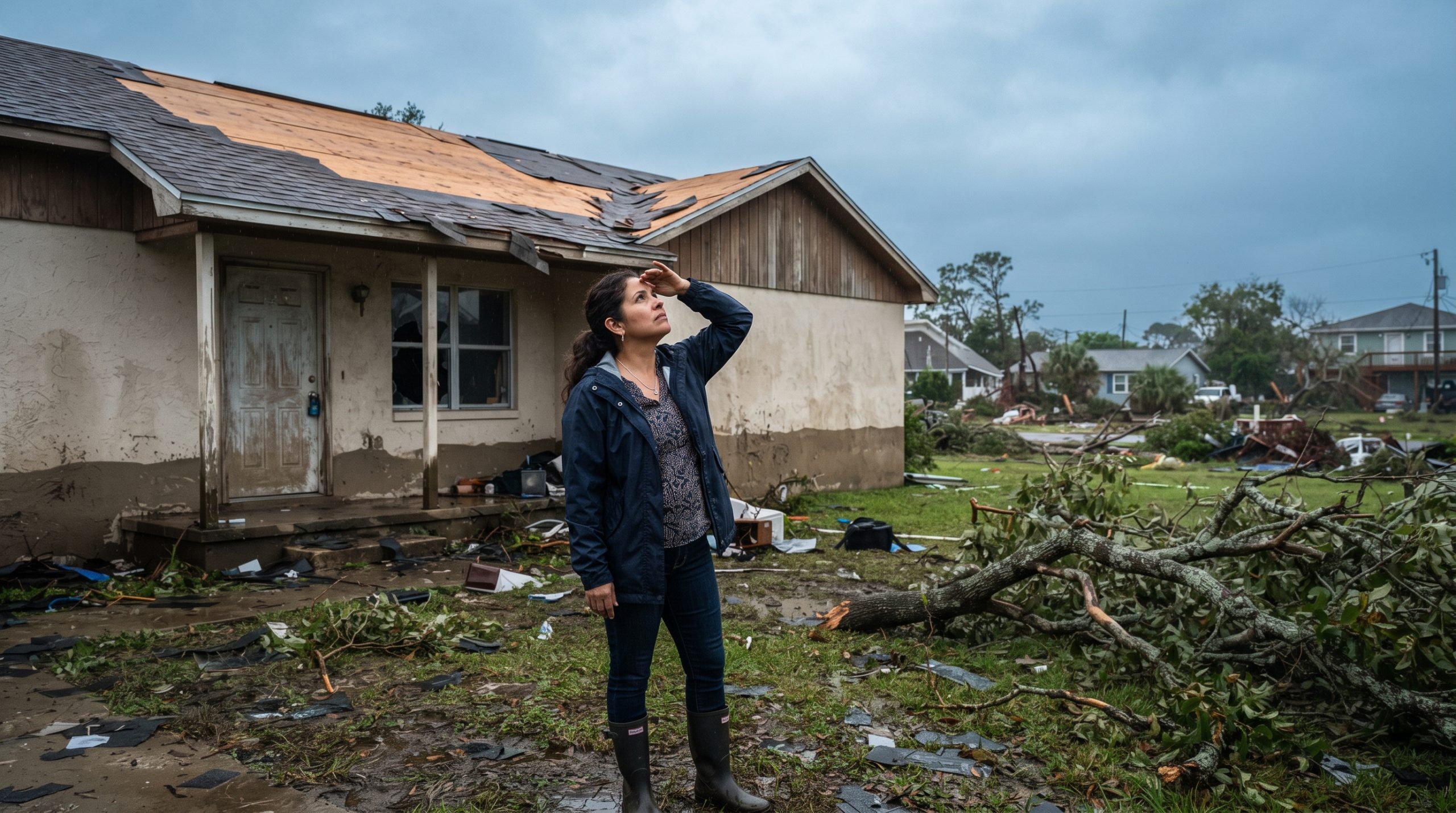
Adriana Fuentes’s roof lost most of its shingles to 100 mph wind gusts hours before storm surge reached her street in Bay St. Louis, Mississippi. By the next morning, her one-story home carried $80,000 in proven wind damage and $150,000 in water damage from the surge that followed, a $230,000 total loss. Her insurer denied the entire claim in one letter, citing a single clause buried in her policy: the anti-concurrent causation clause. It did not matter that the wind hit first. It only mattered that water touched the loss at all.
What the clause actually says
The anti-concurrent causation (ACC) clause sits inside the exclusions section of a standard homeowners policy built on the Insurance Services Office (ISO) HO-3 form. The current specimen version, filed by an admitted carrier with the state of Maine, states that the insurer will not pay for a loss caused “directly or indirectly” by an excluded peril, and that the exclusion applies “regardless of any other cause or event contributing concurrently or in any sequence to the loss.” The flood exclusion it attaches to specifically names storm surge, “all whether or not driven by wind.” That last phrase is doing the real work. It defines wind-driven storm surge as excluded water before the ACC clause even has to engage.
The Katrina case that upheld a full denial
The clearest test of this language came out of Hurricane Katrina. In Leonard v. Nationwide Mutual Insurance Co., 499 F.3d 419 (5th Cir. 2007), a Mississippi homeowner’s property took both hurricane-force wind and a storm surge that flooded the ground floor. The Fifth Circuit sorted the possible damage into three categories: loss caused exclusively by wind, loss caused exclusively by water, and loss caused by wind and water acting together. The court held that “the only species of damage covered under the policy is damage caused exclusively by wind,” and that when “wind and water synergistically caused the same damage, such damage is excluded.” The homeowners recovered only for the portion of the roof they could prove wind alone had destroyed. Everything touched by both wind and surge was barred, in full, with no partial payment.
Mississippi’s own supreme court read it differently
Two years later, the Mississippi Supreme Court faced the identical clause language, on a claim from the same stretch of Gulf Coast, and reached the opposite conclusion. In Corban v. United Services Automobile Association (USAA), 20 So. 3d 601 (Miss. 2009), the court ruled that the exclusion “applies only in the event that the perils act in conjunction, as an indivisible force, occurring at the same time, to cause direct physical damage resulting in loss.” If wind damage happens before or after water damage, the court held, quoting a federal district judge’s reasoning from a related Katrina case with approval, “wind and water are separate and not concurrent causes of the damage,” and the ACC clause “has no application” to the portion caused by wind alone.
For a claim like Adriana’s, that difference decides the entire $80,000 wind-only portion of the loss. Under the Leonard reading, any inability to cleanly separate wind from water sinks the whole claim. Under the Corban reading, proven timing is enough to carve the wind damage back out as a covered loss in its own right.
Why two separate policies make this worse

Part of why this dispute happens at all is structural. The Insurance Information Institute states plainly that “there is no coverage for flooding in standard homeowners or renters policies or in most commercial property insurance policies.” Flood and storm surge require a separate policy, typically through the National Flood Insurance Program (NFIP) or a private flood carrier, adjusted by a different company using different evidence. A single storm produces two claims, two adjusters, and a live factual argument over which peril did what, which is exactly the dispute an ACC clause is built to resolve in the insurer’s favor.
Most homeowners never buy that second policy. The same Insurance Information Institute source found that in 2020, only 27% of American homeowners carried flood insurance, and that even in the highest-risk flood zones, only about 30% of homes had flood coverage. For most people caught in a combined wind-and-surge loss, there is no second policy to fall back on for the excluded half.
| Element of Adriana’s $230,000 loss | Under the Leonard reading (5th Circuit, 2007) | Under the Corban reading (Mississippi Supreme Court, 2009) |
|---|---|---|
| $80,000 in roof damage from wind alone | Covered only if proven exclusively wind, with zero water contribution | Covered as a separate loss if proven to occur before the surge arrived |
| $150,000 in storm-surge water damage | Excluded outright, requires a separate flood policy | Excluded outright, requires a separate flood policy |
| Damage where wind and water effects overlap | Entire overlapping amount denied as one combined loss | Insurer must show the perils acted “in conjunction, as an indivisible force” |
| What actually decides the payout | Whether any water touched the loss at all | Whether the timing of each peril can be documented separately |
How homeowners document their way around it
The Mississippi Supreme Court in Corban adopted the reasoning of a federal district judge from a related Katrina case, Dickinson v. Nationwide, quoting it with approval: “wind damage that precedes flood damage happens in a sequence of events, but the wind damage is not caused, directly or indirectly, by storm surge flooding,” so it is “a covered loss” in its own right. That defense only works with proof of timing.
Timestamped photos or video taken during the storm, before floodwater visibly arrives, are the strongest evidence. Neighbor accounts, doorbell-camera footage, or local news coverage that establish when storm surge actually reached a property help fix the sequence. An engineer’s report that distinguishes wind-pattern damage, missing shingles, blown-in windows above any waterline, from water-line staining and structural saturation gives an adjuster or a court something concrete to work with instead of a single denial letter that treats the whole loss as one event.
Review your policy’s flood exclusion alongside our guide to the homeowners flood coverage exclusion before hurricane season, and compare it against the separate deductible mechanics covered in our guide to wind and hail percentage deductibles. Both clauses can apply to the same storm, and neither one announces itself until a claim is already open.
Frequently asked questions
What is an anti-concurrent causation clause in a homeowners policy? It is an exclusion that denies coverage for a loss caused by an excluded peril, like flood, “regardless of any other cause or event contributing concurrently or in any sequence” to that loss, even when a covered peril like wind also played a role. In practice, it lets an insurer deny an entire combined wind-and-water claim rather than pay for the wind portion alone.
Does homeowners insurance cover storm surge? No. Standard homeowners policies exclude flood and storm surge entirely, including surge driven by hurricane winds. Coverage for that damage comes only from a separate flood policy, typically through the National Flood Insurance Program (NFIP) or a private flood carrier.
Can wind damage be covered even if my area also flooded? It depends on which court’s reading of the anti-concurrent causation clause applies. Under the Fifth Circuit’s approach in Leonard v. Nationwide, combined wind-and-water damage is denied in full. Under the Mississippi Supreme Court’s approach in Corban v. USAA, wind damage proven to occur before the flooding arrived can be paid as a separate, covered loss.
Why did two courts rule differently on the same insurance clause? The Fifth Circuit was applying its own textual reading of the policy language as a federal court. Two years later, the Mississippi Supreme Court interpreted the identical clause under its own state’s law and reached the opposite conclusion, which is now the controlling interpretation for claims governed by Mississippi law.
How do I prove wind damage happened before flood damage in a claim? Timestamped photos or video taken during the storm before water arrives, neighbor or news footage documenting when storm surge reached the property, and an engineer’s report distinguishing wind-pattern damage from water-line damage are the evidence courts have accepted to separate a covered wind loss from an excluded flood loss.
Check what your homeowners policy actually excludes before hurricane season
Compare homeowners insurance coverage now, so a combined wind-and-flood denial letter isn’t the first time you learn what your policy leaves out.
Compare Homeowners Insurance Quotes