6 min read · Last updated July 15, 2026
- Standard homeowners policies universally exclude “earth movement,” which includes earthquakes, landslides, and sinkholes.
- Earthquake coverage is a separate policy or endorsement, and its deductible is a percentage of your dwelling limit, not a flat dollar amount.
- Earthquake deductibles commonly run from 5 percent to 25 percent of the coverage limit, which can be tens of thousands of dollars out of pocket.
- The U.S. Geological Survey puts some level of earthquake risk in nearly every state, not just California.
In this article
- Your standard policy excludes earthquake damage
- Earthquake coverage is a separate purchase
- The percentage deductible is the real shock
- Who actually needs earthquake coverage
- Frequently asked questions
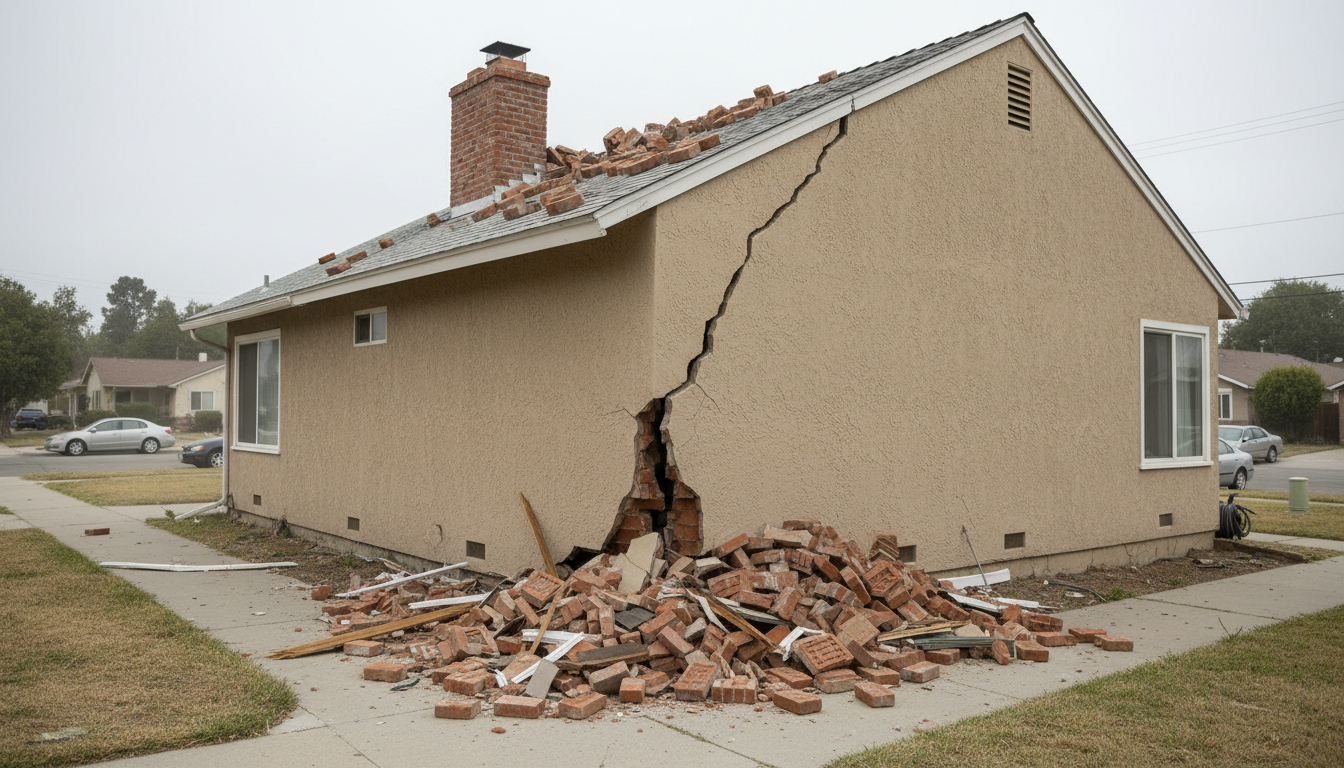
When a magnitude-5.9 quake struck near Ontario, California, the Reyes family had about $140,000 in damage to their $400,000 home: a cracked foundation, a collapsed chimney, and a buckled interior wall. They had bought earthquake coverage the year before, so they expected a check. Then the adjuster explained their 15 percent deductible. On a $400,000 dwelling limit, that meant the first $60,000 of repairs came out of their own pocket before the policy paid a dollar. The coverage they thought would rebuild their home covered barely more than half the loss.
Your standard policy excludes earthquake damage
Nearly every standard homeowners policy in the country contains an earth movement exclusion. It removes coverage for damage caused by earthquakes, landslides, mudslides, and sinkholes. This is not a loophole an adjuster invents after the fact. It is printed in the policy, and it applies whether the ground shifts slowly over years or violently in thirty seconds.
The exclusion is the same clause that surprises homeowners after their foundation cracks from earth movement. It sits alongside the other big standard exclusion most people misjudge, the one that leaves flood damage uncovered without a separate flood policy. The pattern is worth internalizing: the two disasters most likely to destroy a home, water from below and ground movement, are the two your standard policy specifically will not pay for.
Earthquake coverage is a separate purchase
To be covered, you buy earthquake protection separately, either as a standalone policy or as an endorsement added to your homeowners policy. In California, much of this coverage is written through the California Earthquake Authority, a publicly managed insurer, though private options exist too. The California Department of Insurance earthquake guide walks through how the coverage is structured and priced.
A typical earthquake policy covers three things: the structure itself, your personal belongings, and additional living expenses if you are displaced while the home is repaired. The coverage limits usually track your homeowners policy. The deductible does not.
The percentage deductible is the real shock
Here is the part that catches people. On a standard homeowners claim, your deductible is a flat number, often $1,000 or $2,500. On an earthquake policy, the deductible is a percentage of your dwelling coverage limit, commonly ranging from 5 percent to 25 percent. On a $400,000 home, that is $20,000 at the low end and $100,000 at the high end before the policy pays anything.
This is the same mechanic that trips up homeowners with wind and hail percentage deductibles in hurricane-prone states, just applied to a different peril. Run the math on your own home before you assume the coverage will help.
| Deductible | Out of pocket on a $400,000 home | Policy pays on $140,000 of damage | Policy pays on $40,000 of damage |
|---|---|---|---|
| 5% | $20,000 | $120,000 | $20,000 |
| 10% | $40,000 | $100,000 | $0 |
| 15% | $60,000 | $80,000 | $0 |
| 20% | $80,000 | $60,000 | $0 |
| 25% | $100,000 | $40,000 | $0 |

The table shows why the deductible choice is the whole decision. A 25 percent deductible keeps your premium low, but a $40,000 quake, which is a very common loss, pays you nothing. A 5 percent deductible costs more each year but actually responds to the moderate quakes most people experience.
Who actually needs earthquake coverage
Earthquake risk is not a California-only problem. The U.S. Geological Survey’s earthquake hazard mapping shows meaningful risk across the Pacific Northwest, the Intermountain West, parts of the central U.S. near the New Madrid seismic zone, and pockets of the East Coast. The Insurance Information Institute’s earthquake facts note that only a minority of homeowners in high-risk states actually carry the coverage.
Whether it is worth it comes down to three things: your home’s seismic risk, how much of the rebuild cost you could absorb yourself, and whether your foundation and framing are old enough to be vulnerable. If a total loss would financially wipe you out and you live in a moderate-to-high risk zone, the coverage earns its premium even with a percentage deductible. If you could self-fund a partial loss and your risk is low, the math may favor skipping it. Either way, decide it deliberately. Do not let the earth movement exclusion decide it for you after the ground has already moved. And make sure your underlying rebuild limit is high enough in the first place, covered in our guide to extended versus guaranteed replacement cost.
Frequently asked questions
Does homeowners insurance cover earthquake damage? No. Standard homeowners policies contain an earth movement exclusion that removes coverage for earthquakes, landslides, and sinkholes. You need a separate earthquake policy or endorsement to be covered.
Why is the earthquake deductible a percentage instead of a flat amount? Earthquake losses tend to be catastrophic and widespread, so insurers use a percentage of your coverage limit to share more of the risk with the homeowner. It keeps the coverage available and priced, but it means your out-of-pocket cost scales with your home’s value.
How much is an earthquake deductible on a $400,000 home? It depends on the percentage you choose. A 10 percent deductible is $40,000, a 15 percent deductible is $60,000, and a 25 percent deductible is $100,000. You pay that amount before the policy contributes anything.
Do I need earthquake insurance if I do not live in California? Possibly. The U.S. Geological Survey maps meaningful earthquake risk in the Pacific Northwest, the Intermountain West, the central U.S. near the New Madrid zone, and parts of the East Coast. Check your area’s hazard level before assuming you are safe.
Will my standard policy pay for a fire that starts because of an earthquake? Often yes. Many policies include ensuing loss coverage, so if a quake triggers a fire, the fire damage may be covered even though the direct earthquake damage is not. Read your policy language and confirm with your insurer.
Know what your home policy actually covers
Compare homeowners and earthquake coverage options and see the deductible math for your home’s value.
Compare homeowners insurance quotes