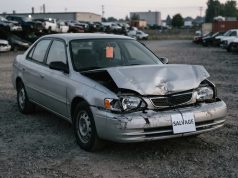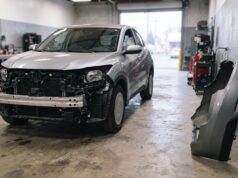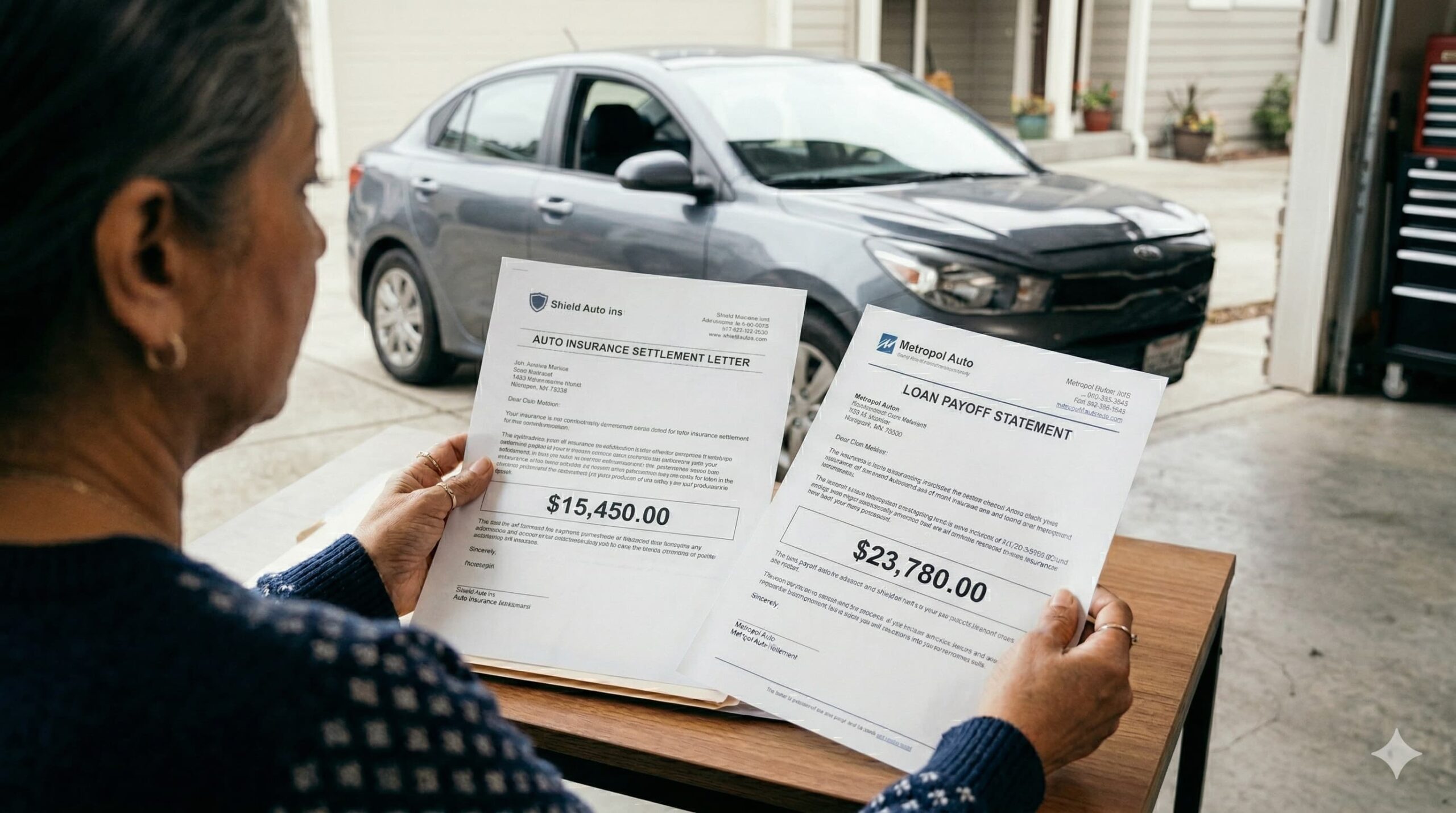
The insurance adjuster offered Priya $22,400 for her totaled SUV. That was exactly $7,300 less than she still owed the bank, and not a dollar of it covered by her comprehensive and collision policy.
Priya had financed a new midsize SUV for $31,500 fourteen months earlier. She made every payment on time. She carried comprehensive and collision coverage, which she assumed meant she was fully protected against a total loss. When another driver ran a red light and destroyed her vehicle, her insurer assessed the actual cash value at $22,400 using current market data, depreciation schedules, and comparable vehicle sales in her area. Her outstanding loan balance was $29,700. The insurer cut a check for $22,400, which went directly to her lender. Priya still owed $7,300 on a vehicle she no longer owned. She had never been offered GAP insurance at the dealership, and no one had explained that her comprehensive and collision policy was designed to pay the market value of her car, not the balance on her loan.
Your collision coverage pays what your car is worth the day it’s totaled. Your lender wants what you owe them. GAP insurance is the only thing that closes that gap.
Actual Cash Value: Why the Number Is Almost Never What You Expect
When an auto insurer declares a vehicle a total loss, the settlement is based on actual cash value (ACV): what the car was worth on the open market immediately before the loss. That number is calculated using depreciation models, mileage adjustments, vehicle condition, and recent comparable sales in the local market. It is not based on what you paid for the car, what you owe on it, or what a dealer would ask for a similar used vehicle on their lot.
The difference between ACV and what you feel your car is worth often comes as a shock, especially on a newer vehicle. Comprehensive and collision coverage is designed to make you whole for the loss of the vehicle’s value. It is not designed to pay off your financing agreement. Those are two different obligations, and the insurance policy only addresses one of them.
Policyholders have the right to dispute the ACV valuation and provide their own comparable market data. But even after negotiation, the ACV of a vehicle that has depreciated significantly will often still fall short of an outstanding loan balance.
The Depreciation Math Nobody Explained at the Dealership
A new vehicle loses approximately 15 to 20 percent of its value in the first year of ownership. By the end of year three, most vehicles have lost 40 to 50 percent of their original purchase price. Depreciation doesn’t pause because you’re still paying off your loan.
On a typical 60-month auto loan with a small down payment, a buyer is “underwater” (meaning they owe more than the vehicle is worth) for roughly the first two to three years. The loan amortization schedule pays down interest heavily in the early months, so the principal balance declines slowly while the vehicle’s value declines faster. The crossover point at which the loan balance falls below the vehicle’s market value depends on the vehicle, the interest rate, the loan term, and the size of the down payment.
A buyer who financed $31,500 with $1,500 down on a 60-month loan at 7% interest and then totaled the vehicle at 14 months would likely find their outstanding balance somewhere in the $27,000 to $30,000 range, while the vehicle’s ACV has already fallen to $22,000 to $24,000. That gap, roughly $5,000 to $8,000, is the buyer’s personal financial exposure, with no insurer obligated to cover it.
Most financed vehicles are worth less than the loan balance for the first two to three years. GAP insurance covers the exact window where your insurer’s check and your loan payoff don’t match.
What GAP Insurance Is and What It Actually Covers
The Consumer Financial Protection Bureau describes Guaranteed Asset Protection (GAP) insurance as covering the difference between the ACV settlement from your auto insurer and the remaining balance on your auto loan or lease at the time of a total loss. If your insurer pays $22,400 on a vehicle with a $29,700 loan balance, a GAP policy covers the $7,300 difference.
GAP coverage is available through three channels, and the cost varies significantly depending on which you use. Dealerships offer GAP insurance through their finance and insurance offices, typically for $400 to $700 bundled into the loan, meaning you pay interest on the GAP premium for the life of the loan. Banks and credit unions sometimes offer it at purchase for a one-time fee in the $200 to $400 range. Most major auto insurers offer GAP coverage as an endorsement to your existing policy for roughly $20 to $100 per year, added directly to your premium.
The insurer route is almost always the least expensive option for someone who already has comprehensive and collision coverage. If you purchased GAP through a dealership and are now past the early years of your loan when you’re most exposed, it may be worth canceling the dealer product and adding the endorsement through your insurer instead.
One important note: lease agreements for new vehicles typically include GAP coverage as a standard provision. If you’re financing rather than leasing, you do not receive GAP coverage by default, even though your financial exposure to a total loss gap is essentially identical.
Questions to Ask Before You Drive Off the Lot or at Your Next Policy Renewal
- What is the current actual cash value of my vehicle, and how does it compare to my outstanding loan balance?
- Does my current auto policy include GAP coverage as a standard component, or is it an add-on I need to request?
- If I purchased GAP through the dealership, how much did it cost, and am I still within the window where the gap risk justifies the premium?
- Can I add GAP coverage through my insurer for less than what I’m currently paying through the dealership?
- If I’m leasing rather than financing, is GAP already included in my lease agreement?
Priya’s insurer didn’t do anything wrong. Her policy performed exactly as written. The $7,300 she still owed the bank was a gap that existed the moment she drove off the lot, and the only product designed to cover it was one she never knew she needed. For more on how coverage decisions affect your total auto insurance cost, see The Different Types of Auto Insurance Coverage Explained. And if you’re trying to understand what else affects your rate, 10 Factors That Affect Your Auto Insurance Rates covers the full picture.
Financing a car? Find out if your coverage closes the gap.
Most financed vehicles are worth less than the loan balance for the first 2-3 years. GAP coverage through your insurer typically costs $20 to $100 a year.